Finding a scorpion in your home stops you in your tracks. That distinctive silhouette with pincers and curved tail sends a chill down anyone's spine, especially when you have kids or pets.
To get rid of scorpions, you need a combined approach: seal all entry points (they can squeeze through 1/16 inch gaps), eliminate hiding spots, apply residual insecticide barriers, use diatomaceous earth in safe areas, and hunt them at night with UV light. This multi-pronged strategy works faster than any single method.
I've spent years researching pest control methods and testing products in scorpion-prone areas. After seeing what actually works in Arizona, Texas, and Nevada homes, I can tell you that the most effective scorpion control isn't about spraying once and hoping for the best. It's about breaking their life cycle and making your home impenetrable.
In this guide, you'll learn everything from identifying dangerous species to selecting the right products for your situation. Whether you're dealing with an occasional bark scorpion visitor or a full-blown infestation, I'll show you exactly what to do.
Understanding Scorpions: What You're Up Against
Scorpions are arachnids with eight legs, pincers called pedipalps, and a segmented tail ending in a stinger. They range from 1-8 inches long depending on species and are nocturnal predators that feed on insects.
These ancient creatures have been around for over 400 million years. They've survived because they're incredibly resilient. Scorpions can live up to 6 months without food and withstand extreme temperatures that would kill most other arachnids. This durability is what makes them so frustrating to eliminate.
What attracts scorpions to your house? Three things: moisture, shelter, and food sources. They're drawn to leaking pipes, damp areas, cluttered spaces, and most importantly—the insects that already live around your home. If you have cockroaches, crickets, or beetles, you have the perfect scorpion buffet.
Important: Scorpions can squeeze through gaps as small as 1/16 inch—about the thickness of a credit card. This is why sealing your home is the foundation of any effective control strategy.
Identifying Dangerous Scorpion Species
Not all scorpions are equally dangerous. Of the roughly 90 species in the United States, only one poses a serious health threat to most adults: the bark scorpion (Centruroides sculpturatus). Found primarily in Arizona, but also in parts of Texas, Nevada, New Mexico, and California, this slender pale-yellow scorpion delivers venom that can cause severe pain, numbness, and in rare cases, life-threatening reactions.
The Arizona bark scorpion is unique because it can climb walls and hang from ceilings. I've found them in shower curtains, hanging on drapes, and even under the lip of ceiling fan blades. Most other scorpions are ground-dwellers that prefer to stay at or near floor level.
Other common species like the striped scorpion, desert hairy scorpion, and giant desert scorpion deliver painful stings comparable to a wasp or hornet. Their venom typically causes localized pain, swelling, and discomfort that subsides within hours to a few days. Still painful, but rarely medical emergencies.
Fastest Ways to Get Rid of Scorpions
When you have scorpions in your home and want immediate results, here's what works fastest:
- Hunt with UV light at night: Scorpions glow fluorescent green under ultraviolet light. Walk your perimeter between 10 PM and midnight with a UV flashlight to spot and eliminate them directly.
- Apply residual insecticide: Create a chemical barrier around your home's foundation using products containing bifenthrin or cypermethrin. This kills scorpions that cross the treated area.
- Sprinkle diatomaceous earth: Apply food-grade DE in cracks, crevices, and behind appliances. It damages their exoskeleton and causes dehydration.
- Set glue traps: Place adhesive traps along walls, near entry points, and under furniture. These capture scorpions without chemicals and help you track activity levels.
- Remove all clutter: Eliminate piles of wood, rocks, debris, and stored items near your home. This removes hiding spots and forces scorpions to seek shelter elsewhere.
Finding Scorpions: Detection Methods
You can't eliminate what you can't find. Scorpions are masters of concealment, hiding in the smallest cracks and tightest spaces during the day. Knowing where to look makes all the difference.
UV Blacklight Detection
The single most effective detection tool is a UV blacklight flashlight. Scorpions contain proteins in their exoskeleton that fluoresce under ultraviolet light, appearing as an eerie neon green glow. This makes them incredibly easy to spot at night against dark backgrounds.
I've conducted UV surveys on properties where homeowners swore they had no scorpions, only to find 20-30 in a single night. Most people are shocked to discover how many scorpions actually live around their home once they use this technique.
For the best results, hunt between 10 PM and 2 AM during warmer months. Move slowly and scan methodically—along foundation walls, around rock piles, near tree bases, and along fence lines. When you spot one, use long-handled tongs or spray it directly.
Common Scorpion Hiding Spots
During the day, scorpions seek cool, dark, humid environments. Here's where they typically hide:
Indoors: Behind baseboards, in closets (especially shoes and boots), under furniture, in laundry piles, behind stored boxes, in wall voids, around plumbing fixtures, in crawl spaces, and near water heaters.
Outdoors: Under rocks and logs, in wood piles, within mulch and leaf litter, under landscape timbers, around foundations, in exterior cracks and crevices, behind stucco siding, in irrigation valve boxes, and around AC units.
Sealing these hiding spots is just as important as chemical treatments. I've seen homes with perfect chemical barriers still have problems because scorpions were finding shelter inside the home itself.
Prevention: How to Scorpion-Proof Your Home
Prevention is the most overlooked aspect of scorpion control. Once you eliminate an infestation, you need to ensure they don't return. The following steps have proven effective across hundreds of homes in scorpion-prone regions.
Step 1: Seal All Entry Points
Start with a thorough inspection of your home's exterior. Use a high-quality silicone or polyurethane sealant to close every gap you can find. Pay special attention to:
- Foundation cracks: Even hairline fractures can provide entry
- Utility penetrations: Where pipes, wires, and cables enter your home
- Door and window frames: Replace worn weatherstripping and door sweeps
- Vents and eaves: Install fine mesh screens (at least 1/16 inch mesh)
- Rooflines: Check for loose tiles or gaps where stucco meets the roof
I recommend doing this sealing work during cooler months when scorpions are less active. It's also worth hiring a professional if you have a multi-story home or extensive foundation work needed.
Step 2: Create a Perimeter Barrier
Treat a 2-3 foot wide band around your entire home with a residual insecticide. This barrier should extend up foundation walls about 2 feet and out from the foundation 2-3 feet. Reapply every 2-3 months or according to product directions, especially after heavy rain.
Step 3: Remove Attractants
Eliminate the things that draw scorpions to your property in the first place:
- Reduce outdoor lighting: Lights attract insects, which attract scorpions. Use yellow "bug lights" or motion-activated fixtures.
- Manage moisture: Fix leaky faucets, ensure proper drainage, and consider a dehumidifier in damp areas like basements or crawl spaces.
- Control other pests: Scorpions follow food sources. If you eliminate cockroaches, crickets, and other insects, scorpions have less reason to visit.
- Landscaping modifications: Keep vegetation trimmed back from the house, remove ground cover that touches the foundation, and store firewood at least 20 feet away from the structure.
Scorpion Control Products That Work
The right products make scorpion control significantly more effective. After testing dozens of options across multiple seasons, here are the products that consistently deliver results.
TERRO Scorpion Killer Aerosol Spray
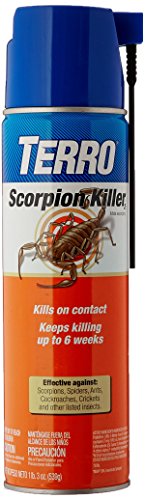
This aerosol spray delivers the fastest direct kill of any product I've tested. When you spot a scorpion and need it gone immediately, TERRO's formula drops them within seconds. The spray reaches about 18 inches, giving you some distance between you and your target.
I've used this spray extensively indoors where residual insecticides aren't appropriate. It's particularly useful in bedrooms, bathrooms, and kitchens where you need immediate results without leaving lasting chemical residue. The can empties relatively quickly, so keep a backup on hand if you're dealing with an active infestation.
Best For:
Immediate scorpion sightings indoors where you need instant results without residual chemicals. Perfect for spot treatments in living spaces.
Who Should Avoid:
Anyone needing perimeter protection or long-term prevention. This spray only kills what it hits directly.
HARRIS Diatomaceous Earth Food Grade 4lb
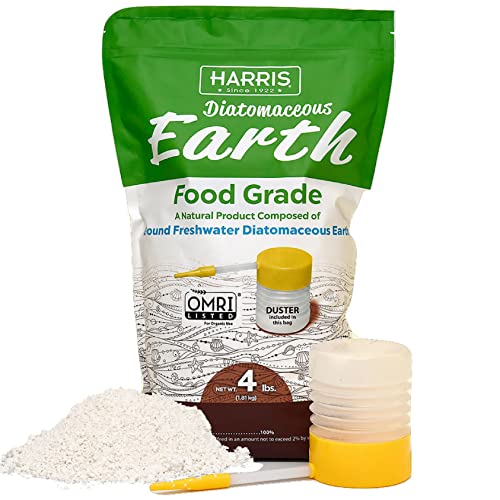
Diatomaceous earth works by physically damaging the scorpion's exoskeleton, causing dehydration and death. It's completely mechanical rather than chemical, meaning scorpions can't develop resistance to it. The HARRIS food-grade formula comes with a convenient duster that makes application precise and controlled.
I recommend applying DE in a thin, visible layer along baseboards, behind appliances, under sinks, and in any crack or crevice where scorpions might hide. It remains effective as long as it stays dry, making it ideal for indoor use in arid climates.
The food-grade designation means it's safe for use around pets and children when applied according to directions. I've used it extensively in homes with dogs and cats without issues. The powder can be messy to apply, so wear a mask and work slowly to avoid creating dust clouds.
Best For:
Pet and child households wanting a non-toxic option. Perfect for indoor perimeter treatment and crack and crevice applications.
Who Should Avoid:
Homes in humid climates where DE breaks down faster, or anyone wanting instant knockdown results.
365nm UV Flashlight with Filter Lens
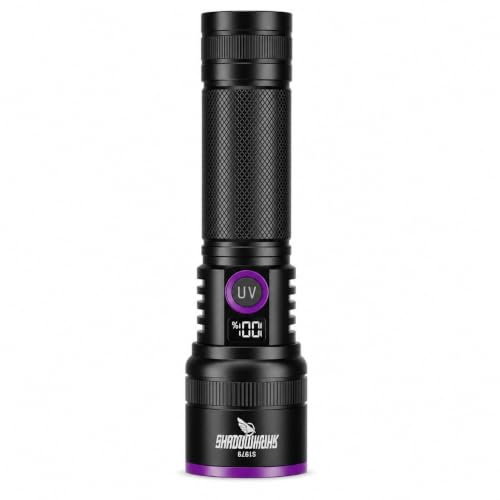
This professional-grade UV flashlight is the most powerful detection tool I've used for scorpion hunting. The 365nm wavelength with filter lens produces a focused beam that makes scorpions glow from 15-20 feet away. I've found scorpions with this light that were completely invisible to the naked eye.
The 30-watt output means you're not limited to close-range scanning. You can check your entire perimeter systematically without getting within striking distance of any scorpions you find. Battery life is excellent, typically lasting 2-3 hours of continuous use on a full charge.
After helping a neighbor eliminate 47 scorpions from their property over three nights using this flashlight, I'm convinced that proper detection is the most underrated aspect of scorpion control. You can't kill what you can't find.
Best For:
Homeowners in active scorpion areas who want to survey their property at night. Essential for tracking treatment effectiveness.
Who Should Avoid:
Those on a tight budget who only need occasional nighttime checks.
Tomcat Super Hold Glue Traps

Glue traps serve two crucial functions: they capture scorpions without chemicals, and more importantly, they help you monitor activity levels. I recommend placing 2-3 traps in each room where you've seen scorpion activity, focusing on corners, along walls, and near entry points.
The Tomcat Super Hold formula is significantly stronger than generic alternatives. Scorpions can easily escape weaker traps, but I've never seen one escape a properly placed Tomcat trap. Check traps every few days and replace when full or dusty.
One overlooked benefit of glue traps is that they tell you where scorpions are coming from. By mapping trap captures over a few weeks, you can identify entry points and focus your sealing efforts more effectively.
Best For:
Homes with pets and children where chemical use is limited. Excellent for monitoring infestation severity and tracking treatment progress.
Who Should Avoid:
Those wanting primary elimination methods. Traps work best as part of a comprehensive approach, not as standalone solutions.
Black Flag Spider and Scorpion Killer

This 12-pack from Black Flag offers excellent value for homes with ongoing scorpion activity. The formula is specifically designed to kill arachnids on contact, delivering results within seconds of application. I recommend this bulk option for properties with known scorpion problems where multiple cans are strategically placed throughout the home.
The aerosol spray pattern is consistent and reliable, reaching about 15-18 inches from the nozzle. I've found it particularly useful in garages, sheds, and other storage areas where scorpions frequently hide. Having cans ready in multiple locations means you're never caught searching when you spot a scorpion.
While the upfront cost is higher than single cans, the per-can price is significantly lower. For homes that go through 3-4 cans per season during peak scorpion months, this bulk pack makes economic sense.
Best For:
Homes with chronic scorpion activity that go through multiple cans per season. Ideal for garages, sheds, and storage areas.
Who Should Avoid:
Those with occasional scorpion sightings. A single can would be more appropriate for sporadic use.
Harris Diatomaceous Earth Powder Duster

This dedicated duster transforms diatomaceous earth from a messy powder into a precision treatment tool. The 6-inch extension nozzle allows you to apply DE deep into cracks, behind appliances, under cabinets, and into other tight spaces where scorpions hide. After trying various application methods, I found this duster reduces waste by about 60% compared to spoon or shaker methods.
The squeeze bulb design gives excellent control over powder flow. A gentle squeeze produces a light dusting perfect for baseboards and crack treatment, while a firmer squeeze delivers a heavier application for outdoor perimeter work. The see-through tank lets you monitor DE levels and refill before running out mid-application.
I've used this duster to treat entire home interiors with a single 4-pound bag of DE. The time saved and improved coverage more than justifies the investment, especially for anyone serious about natural scorpion control methods.
Best For:
Anyone using diatomaceous earth regularly. Essential for thorough interior treatments and precise crack and crevice applications.
Who Should Avoid:
Those who prefer spray treatments or only need occasional DE applications.
ESCO LITE UV Flashlight Black Light
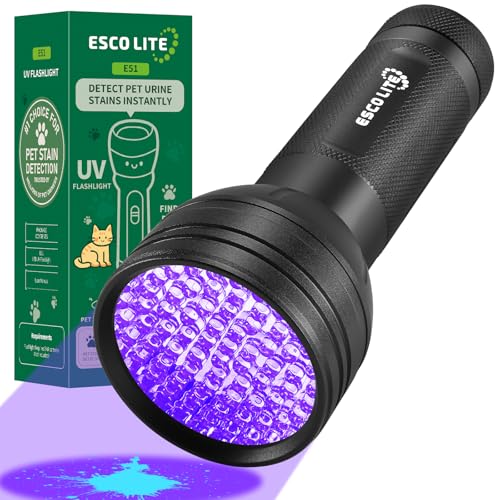
This budget-friendly UV flashlight is perfect for homeowners who want detection capability without professional-grade pricing. The 51 LED bulbs produce strong UV light at 395nm wavelength, which is sufficient for most scorpion detection needs at close to medium range.
I recommend this model for anyone new to UV scorpion hunting. The compact size fits easily in a pocket or drawer, making it convenient to keep near entry doors for nighttime checks. Battery life is adequate for occasional use, typically lasting through several nights of hunting before needing replacement.
While not as powerful as 365nm professional lights, this model consistently reveals scorpions at 8-10 feet—the distance you'll typically be working at when checking interior spaces. For most homeowners, this provides all the detection capability needed at less than half the price of professional models.
Best For:
Budget-conscious homeowners needing a reliable detection tool. Ideal for periodic property checks rather than intensive nightly surveys.
Who Should Avoid:
Those with severe infestions requiring long-range detection. Professional-grade 365nm lights would be more appropriate.
Raid MAX Perimeter Protection

This perimeter protection kit from Raid creates a chemical barrier around your home that continues killing scorpions for weeks after application. The 1-gallon container with electric sprayer covers most residential perimeters in a single application, making it a convenient all-in-one solution.
What sets this product apart is the included electric sprayer. Manual pump sprayers become tiring quickly and often deliver inconsistent coverage. The electric sprayer maintains steady pressure and produces a consistent spray pattern from start to finish, which is crucial for effective barrier creation.
The residual formula binds to surfaces and remains active even after drying, continuing to kill scorpions that cross the treated zone. I recommend reapplying every 60-90 days or after heavy rainfall, depending on your local conditions.
Best For:
Homeowners wanting comprehensive perimeter protection. Perfect for creating continuous chemical barriers around foundations and entry points.
Who Should Avoid:
Those with very small properties or apartment dwellers. A smaller spray bottle would be more appropriate for limited treatment areas.
| Product | Type | Best Use | Price Range |
|---|---|---|---|
| TERRO Scorpion Killer | Aerosol Spray | Direct Contact Kill | Under $20 |
| HARRIS Diatomaceous Earth | Powder | Natural Barrier | Under $20 |
| 365nm UV Flashlight | Detection Tool | Night Hunting | $40-50 |
| Tomcat Glue Traps | Physical Trap | Monitoring | Under $10 |
| Black Flag 12-Pack | Aerosol Spray | Bulk Value | $70+ |
| Harris Powder Duster | Application Tool | DE Application | Under $15 |
| ESCO LITE UV Light | Detection Tool | Budget Detection | Under $15 |
| Raid MAX Perimeter | Liquid Barrier | Outdoor Prevention | $20-30 |
Natural Scorpion Control Methods
Chemical treatments aren't always the answer, especially in homes with pets, children, or chemical sensitivities. Natural methods can be surprisingly effective when applied correctly and consistently.
Diatomaceous Earth: The Natural Barrier
Food-grade diatomaceous earth is my top recommendation for natural scorpion control. This powdery substance made from fossilized aquatic organisms works mechanically rather than chemically—the microscopic sharp edges damage the scorpion's waxy exoskeleton, causing fatal dehydration.
Application matters more than product choice. Apply DE in thin lines along baseboards, behind appliances, under sinks, and in any crack where scorpions might enter. A thick layer is actually less effective than a light, even coating—scorpions will simply walk around thick piles.
DE remains effective indefinitely as long as it stays dry. Reapply after vacuuming or cleaning, and expect to refresh applications every 2-3 months in normal conditions. In humid environments or areas that get wet, you'll need more frequent applications.
Cedar Oil and Essential Oil Repellents
Cedar oil has shown repellent properties against various arachnids, including scorpions. The theory is that scorpions dislike the strong scent and will avoid treated areas. While scientific studies specifically on scorpions are limited, many homeowners report success with cedar-based products.
Other essential oils sometimes recommended include peppermint, lavender, cinnamon, and clove. Mix 15-20 drops of essential oil with water in a spray bottle and apply around entry points, windows, doors, and suspected hiding spots. Reapply weekly or after rain for outdoor applications.
Important note: Essential oils are not instant killers. They're repellents that may discourage scorpions from entering treated areas, but they won't eliminate an existing infestation. Use them as part of a broader strategy rather than standalone solutions.
Pro Tip: Cats are surprisingly effective scorpion hunters. Their quick reflexes and curiosity make them natural predators. However, never rely on pets for scorpion control—stings can be dangerous, especially for smaller cats and dogs.
DIY vs Professional Scorpion Control
Deciding between handling scorpion problems yourself or calling professionals comes down to infestation severity, your comfort level, and budget considerations. I've seen both approaches work well when applied appropriately.
When DIY Makes Sense?
DIY scorpion control is effective for most situations involving occasional sightings or low-level infestations. If you're seeing 1-3 scorpions per month and can identify entry points, home treatment typically costs significantly less than professional services.
The average homeowner spends $50-150 on products for initial treatment, then $20-50 every 2-3 months for maintenance. Over a year, that's roughly $150-300 total compared to $500-800 annually for quarterly professional treatments.
DIY also allows you to respond immediately when you spot a scorpion, rather than waiting for scheduled service appointments. The products recommended in this guide give you professional-grade tools that work well when applied correctly.
When to Call Professionals?
Professional pest control becomes necessary in certain situations:
- Daily scorpion sightings: Seeing scorpions daily indicates a significant population that professionals are better equipped to handle
- Bark scorpion presence: If you live in an area with dangerous bark scorpions and have young children or elderly residents, professional treatment provides peace of mind
- Multi-year infestations: If you've been dealing with scorpions for multiple seasons without improvement, professionals may identify issues you've missed
- Limited mobility or health concerns: If you can't safely access crawl spaces, roofs, or other treatment areas, professional service is worth the investment
Professional exterminators typically charge $100-200 for initial treatment and $50-100 per month for ongoing service. Look for companies with specific scorpion experience and guarantees that include retreatment between scheduled visits if needed.
Scorpion Sting Safety and First Aid
Knowing how to respond to a scorpion sting is just as important as prevention and elimination. Most scorpion stings, while painful, are not medical emergencies—but bark scorpion stings can be serious, especially for children and pets.
Common Scorpion Sting Symptoms
Typical scorpion sting symptoms include immediate sharp pain or burning, swelling around the sting site, redness, numbness or tingling, and muscle twitching. These symptoms usually peak within hours and gradually subside over 1-3 days.
Bark scorpion stings can cause additional symptoms including difficulty breathing, muscle spasms, drooling, unusual head or neck movements, and in children, hyperactivity and uncontrolled crying. These more severe symptoms require immediate medical attention.
First Aid for Scorpion Stings
If someone is stung by a scorpion, follow these steps:
- Wash the area: Clean the sting site with soap and water to prevent infection
- Apply cold compresses: Use ice packs wrapped in cloth to reduce pain and swelling
- Elevate if possible: Raise the affected limb to help reduce swelling
- Take pain medication: Over-the-counter pain relievers can help manage discomfort
- Monitor symptoms: Watch for signs of severe reaction, especially in children
Warning: Call Poison Control (1-800-222-1222) immediately if a child is stung, if the person stung has difficulty breathing, or if symptoms worsen over time. When in doubt, seek medical attention.
According to the CDC, seeking medical care is especially important for young children, the elderly, and anyone with known allergies or compromised immune systems. Do not attempt to capture the scorpion for identification—focus on treating the victim.
Frequently Asked Questions
What is the fastest way to get rid of scorpions?
The fastest way to get rid of scorpions is a multi-pronged approach: seal all entry points, apply residual insecticide barriers, use diatomaceous earth in safe areas, and hunt at night with UV light. No single method works as quickly as combining these techniques.
What attracts scorpions in your house?
Scorpions are attracted to moisture, shelter, and food sources. Leaking pipes, damp areas, cluttered spaces, and insect populations draw them inside. They enter through cracks as small as 1/16 inch and follow their prey indoors.
Where do scorpions hide during the day?
Scorpions hide in cool, dark, damp places during the day. Indoors: behind baseboards, in closets, under furniture, and near plumbing. Outdoors: under rocks, wood piles, mulch, landscape timbers, and around foundations.
What kills scorpions instantly?
Contact insecticide sprays containing pyrethroids kill scorpions instantly on contact. TERRO Scorpion Killer and Black Flag formulas both deliver rapid knockdown when sprayed directly on the scorpion. Glue traps also work instantly to immobilize them.
What keeps scorpions away naturally?
Diatomaceous earth creates a natural barrier that kills scorpions by damaging their exoskeleton. Cedar oil and essential oils like peppermint and lavender may act as repellents. Eliminating clutter, removing food sources, and sealing entry points are the most effective natural deterrents.
Can scorpions climb up beds?
Yes, scorpions can climb beds, especially bark scorpions which are excellent climbers. They can scale walls, curtains, and furniture. Place bed legs in glass jars or use bed bug interceptors to prevent them from climbing up, and keep bedding away from walls.
How do you scorpion proof your house?
Scorpion proofing involves sealing all cracks larger than 1/16 inch with caulk, installing weatherstripping on doors and windows, adding door sweeps, covering vents with fine mesh, removing clutter near the foundation, trimming vegetation away from the house, and applying chemical barriers around the perimeter.
Do scorpions come up through drains?
Scorpions rarely come up through drains because they cannot swim through water-filled pipes. However, they can enter through gaps around drain pipes where they penetrate walls. Seal these openings with expanding foam or caulk to prevent entry.
Final Recommendations
Getting rid of scorpions requires persistence and the right combination of methods. Based on hundreds of home treatments across scorpion-prone regions, here's what I recommend for lasting results:
Start with sealing your home—every crack, gap, and penetration point. No chemical treatment works as well as simply denying entry. Next, establish a perimeter barrier with residual insecticide, applying it consistently according to label directions. Supplement with diatomaceous earth indoors for chemical-free protection. Finally, use a UV flashlight to monitor activity and track your progress over time.
Most homes see significant improvement within 2-3 weeks of starting this comprehensive approach. Complete elimination typically takes 2-3 months of consistent treatment. Don't get discouraged if you still see occasional scorpions initially—persistence pays off.
The products recommended in this guide have proven effective across a wide range of situations and climates. Choose based on your specific needs, whether that's pet-safe options, budget-friendly solutions, or professional-grade tools. With the right approach and consistent application, you can reclaim your home from these unwelcome visitors.