Buenos Aires Tetra (Psalidodon anisitsi, formerly Hyphessobrycon anisitsi) is a vibrant, active freshwater fish that has earned a reputation as one of the hardiest tetra species available to aquarists in 2026. Native to the rivers and streams of Argentina and Paraguay, particularly the Rio de la Plata basin, these South American characins bring energy and color to community aquariums with their shimmering silver bodies and striking red-orange fins.
Whether you are setting up your first community tank or looking for a dither fish to bring confidence to timid cichlids, Buenos Aires Tetras offer an appealing combination of durability and visual appeal. However, these fish come with an important caveat that every prospective owner must understand: they are notorious plant eaters. This single behavioral trait shapes every aspect of their care, from tank decoration choices to companion species selection.
In this comprehensive care guide, I will walk you through everything you need to know about keeping Buenos Aires Tetras successfully. From their updated scientific classification to their breeding habits, water parameter tolerances, and the critical plant compatibility issue, this guide covers all aspects of Buenos Aires Tetra care based on the latest research and practical experience from the aquarium community.
Table of Contents
- Species Summary
- Care Guide
- Tank Size And Requirements
- Lighting
- AQUANEAT LED Aquarium Light Full Spectrum for...
- Filter
- Tetra Whisper IQ Power Filter, 175 GPH, with Stay...
- Filter Media
- Fluval BioMax Biological Material Remover, 500 g
- Heater
- Orlushy Submersible Aquarium Heater, Adjustable...
- Buenos Aires Tetra Tank Mates
- Tank Decorations and Plant Strategy
- Water Quality Parameters
- API Freshwater Master Test Kit 800-Test Freshwater...
- Water Changes And Maintenance
- Seachem Prime -500 ml/ 17 fl. oz.
- Oxygenation and Water Movement
- Pawfly Aquarium Air Stone 1 Inch, Fish Tank Air...
- Buenos Aires Tetra Potential Fish Diseases
- Disease Prevention
- Recommended Products for Buenos Aires Tetra Care
- Advantages Of Having Buenos Aires Tetra In Your Tank
- Disadvantages Of Having Buenos Aires Tetra In Your Tank
- Frequently Asked Questions
- Are Buenos Aires tetras peaceful?
- How big does a Buenos Aires tetra get?
- Are Buenos Aires tetras good community fish?
- What fish go well with Buenos Aires tetras?
- Are Buenos Aires tetra fin nippers?
- How long do Buenos Aires tetras live?
- Do Buenos Aires tetras eat plants?
- Do Buenos Aires tetras need a heater?
- Conclusion
Species Summary
Buenos Aires Tetras belong to the family Characidae, a diverse group of freshwater fish native to South and Central America. Recent taxonomic revisions have reclassified this species from the genus Hyphessobrycon to Psalidodon, though you will still encounter both names in aquarium literature and fish stores. Understanding their classification helps explain their care requirements and behavioral patterns.
These fish have been aquarium staples since the early twentieth century when they were first collected from their native waters. Their scientific name honors Johann Anisits, a Hungarian naturalist who explored South America in the late 1800s. Common alternative names include Diamond Spot Tetra and Red Cross Fish, both referencing distinctive visual features these fish display.
| Scientific Name: | Psalidodon anisitsi (formerly Hyphessobrycon anisitsi) |
| Common Name(s): | Buenos Aires Tetra, Diamond Spot Tetra, Red Cross Fish |
| Family: | Characidae (Characins) |
| Origin: | Argentina, Paraguay (Rio de la Plata basin) |
| Care Level: | Easy - Beginner Friendly |
| Size: | 2.5 to 3 inches (6-8 cm) |
| Lifespan: | 3 to 5 years (up to 7 with optimal care) |
| Diet: | Omnivore (including plant matter) |
| Minimum Tank Size: | 20-30 gallons |
| School Size: | 6+ individuals |
| Temperament: | Peaceful but boisterous |
| Temperature Range: | 64°-82°F (18°-28°C) |
| Water pH: | 5.5-8.5 (highly adaptable) |
| Water Hardness: | 12-35 dGH |
| Breeding Type: | Egg scatterer (1000-2000 eggs) |
| Special Consideration: | Notorious plant eater |
One of the most appealing aspects of Buenos Aires Tetras is their remarkable hardiness. These fish tolerate a wider range of water parameters than most tetra species, making them ideal for beginners still mastering water chemistry. Their ability to thrive in temperatures as low as 64°F also means they can be kept in unheated aquariums in climate-controlled homes, offering flexibility that many tropical fish cannot match.
When selecting Buenos Aires Tetras from a store, look for active individuals with bright coloration and intact fins. Avoid fish showing clamped fins, labored breathing, or those hiding in corners. Healthy specimens should be swimming actively in the middle water column, displaying their characteristic curiosity and confidence.
Also, check Black Neon Tetra 101 for a comparison with a smaller, more peaceful tetra species.
Buenos Aires Tetra Appearance
Buenos Aires Tetras display a sleek, torpedo-shaped body built for speed and agility in the water. Their base coloration is a brilliant metallic silver that reflects light beautifully, creating a shimmering effect as they move through the aquarium. A distinctive blue iridescent stripe runs horizontally along the midline of their body, catching the light and adding depth to their appearance.
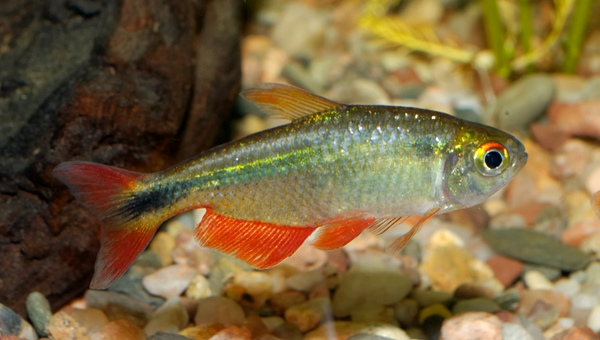
The most striking feature of Buenos Aires Tetras is their fin coloration. All fins, including the dorsal, anal, pelvic, and caudal fins, display vivid shades of red and orange. This coloration becomes particularly intense in well-maintained aquariums with proper nutrition. The forked caudal fin adds to their streamlined appearance and helps them navigate swiftly through the water.
The "Diamond Spot" common name refers to a subtle reflective patch that appears behind the gill cover on some specimens, particularly visible when light hits them at certain angles. Meanwhile, the "Red Cross Fish" name comes from the overall impression created by their red fins against the silver body, though this description is less commonly used today.
Fully grown adults reach lengths of 2.5 to 3 inches, making them among the larger tetra species commonly kept in home aquariums. This substantial size compared to neon tetras or cardinal tetras means they need more swimming space and can coexist with a broader range of tank mates without being intimidated or outcompeted for food.
An albino variant also exists in the aquarium trade, featuring the same body shape and fin structure but with a pale pinkish-white body and red eyes. These albino Buenos Aires Tetras have the same care requirements and behavioral traits as their normally colored counterparts.
Buenos Aires Tetra Behaviour & Temperament
Buenos Aires Tetras display an active, boisterous temperament that sets them apart from the more subdued behavior of smaller tetra species. As schooling fish, they require group housing to feel secure and display their natural behaviors. A minimum school of six individuals is essential, though larger groups of ten or more will show more confident, engaging behavior and create a more impressive visual display as they move together through the water column.
These fish are mid-level swimmers that will utilize all areas of the aquarium but spend most of their time in the middle third of the water column. They are active swimmers, constantly on the move and exploring their environment. This high activity level makes them excellent dither fish for more timid species, as their confident presence encourages shy tank mates to venture out from hiding spots.
However, their boisterous nature comes with behavioral considerations. Buenos Aires Tetras can be fin nippers, particularly toward slow-moving fish with long, flowing fins. They may also chase smaller, more timid species. While not genuinely aggressive in the way cichlids can be, their active, sometimes pushy behavior can stress more peaceful community fish. This temperament makes them better suited to tanks with similarly active or robust species rather than delicate, slow-moving tank mates.
The most significant behavioral trait that shapes Buenos Aires Tetra keeping is their appetite for vegetation. These fish are notorious plant eaters, readily consuming most aquatic plants including favorites like water wisteria, duckweed, and various stem plants. They will systematically strip leaves, leaving only stems and skeletal remains. This behavior is not a sign of poor nutrition but a natural part of their omnivorous feeding strategy in the wild, where they graze on algae and plant material alongside small invertebrates.
Another important behavioral consideration is their tendency to jump. Buenos Aires Tetras are skilled jumpers that can and will leap from open-topped aquariums. This behavior is most common when they are first introduced to a new environment or if startled by sudden movements or lighting changes. A secure, well-fitting lid is not optional but essential for their safe keeping.
Also, check Cardinal Tetra 101 to see how they compare to a more peaceful, smaller tetra species.
Buenos Aires Tetra Food & Diet
As omnivores with a particular fondness for vegetable matter, Buenos Aires Tetras accept a wide variety of foods in the aquarium. Their adaptable feeding habits make them easy to feed, but providing a balanced, varied diet ensures optimal health and coloration. In the wild, they consume algae, plant material, small insects, crustaceans, and other invertebrates found in their riverine habitats.
A quality staple diet should consist of high-quality flake foods formulated for tropical fish. Look for flakes that include spirulina and vegetable matter in addition to protein sources. The vegetable content helps satisfy their natural plant-eating tendencies, though it will not prevent them from consuming live plants in the aquarium. Feed small amounts two to three times daily, offering only what the fish can consume within two to three minutes.
Supplement their diet with regular offerings of protein-rich live or frozen foods. Good options include brine shrimp, bloodworms, daphnia, and tubifex worms. These protein sources support growth, color development, and breeding condition. Frozen foods offer convenience while maintaining nutritional value, while live foods stimulate natural hunting behaviors.
Fresh vegetables can be offered occasionally to satisfy their plant-eating urges. Blanched spinach, zucchini slices, or cucumber pieces will be eagerly accepted and may help reduce their destruction of aquarium plants. Remove uneaten vegetable matter after 24 hours to prevent water quality issues.
Vitamin supplementation through high-quality prepared foods supports long-term health. Foods containing astaxanthin and other carotenoids help enhance their natural red and orange coloration. Occasional fasting days, where food is withheld for 24 hours, can help prevent digestive issues and mimic natural feeding patterns where food may not always be abundant.
Buenos Aires Tetra Lifespan
In optimal aquarium conditions, Buenos Aires Tetras typically live between three to five years. Some individuals have been reported to reach seven years or more with exceptional care, though three to five years represents the realistic expectation for most home aquariums. Their relatively long lifespan for a small fish makes them a worthwhile investment for community tank keepers.
Factors that influence lifespan include water quality maintenance, diet quality, tank size, and stress levels. These hardy fish tolerate a range of conditions, but consistently poor water quality, overcrowding, or aggressive tank mates will shorten their lives. Maintaining stable water parameters, providing a varied diet, and keeping them in appropriately sized groups in adequately sized tanks supports longevity.
Buenos Aires Tetra Gender Differences
Sexing Buenos Aires Tetras becomes easier as they mature, though the differences are subtle compared to some other fish species. Males typically grow slightly larger than females, reaching the upper end of the size range at around 3 inches. They often display more intense coloration, particularly in the red and orange fins, which may appear brighter and more saturated than those of females.
The most reliable indicator of sex is body shape. Females develop a noticeably rounder, fuller body profile, especially when carrying eggs. Their bellies become distended and almost pear-shaped during the breeding season. Males maintain a more streamlined, slender profile throughout their lives. This difference is most apparent when viewing the fish from above or when comparing individuals of similar age side by side.
Buenos Aires Tetra Breeding
Breeding Buenos Aires Tetras is relatively straightforward compared to many other tetra species, making them an excellent choice for aquarists interested in trying their hand at fish breeding. These prolific egg scatterers can produce large numbers of offspring with proper preparation and care.
Sexual maturity is reached at approximately six to eight months of age, though waiting until the fish are at least one year old generally produces better breeding results. The older fish are larger, more robust, and better able to handle the rigors of spawning. Condition potential breeding pairs by feeding them high-quality live and frozen foods for several weeks before attempting to spawn them.
Set up a separate breeding tank of at least 10-20 gallons with sponge filtration to prevent fry from being drawn into the filter. Water parameters should match the main tank, though slightly softer water and a temperature at the upper end of their range (around 78-80°F) can help trigger spawning. Provide plenty of fine-leaved plants or a spawning mop for egg deposition, though be aware that parents will eat any eggs they can reach.

Spawning typically occurs in the early morning hours. The male will chase the female aggressively, nudging her sides and driving her toward the plants. When ready, the female releases eggs among the vegetation while the male simultaneously releases milt to fertilize them. A single female can lay between 1000 and 2000 eggs during a single spawning event.
Remove the parents immediately after spawning is complete, as they will consume the eggs given the opportunity. The eggs hatch in approximately three to five days, depending on temperature. Initially, the fry have yolk sacs and do not require feeding. Once they become free-swimming, typically three to four days after hatching, begin feeding with infusoria or commercially available liquid fry foods like Liquifry.
As the fry grow, transition them to baby brine shrimp and finely crushed flake food. Growth is relatively rapid with proper nutrition and water changes. Regular partial water changes help maintain water quality in the heavily fed breeding tank. The fry will gradually develop their characteristic coloration, with the silver body and blue stripe appearing within a few weeks and full adult coloration developing over several months.
Care Guide
Providing proper care for Buenos Aires Tetras focuses on three primary areas: maintaining adequate water quality, providing appropriate equipment for their needs, and managing their plant-eating behavior through thoughtful tank decoration choices. Their hardy nature makes them forgiving of minor care lapses, but optimal conditions bring out their best coloration and behavior.
Tank Size And Requirements
Buenos Aires Tetras require a minimum tank size of 20-30 gallons for a small school. This size provides sufficient swimming space for their active nature and allows for proper schooling behavior. Larger tanks of 40 gallons or more are preferable, especially if keeping a larger school or housing them with other active community fish.
Their jumping behavior makes a secure lid absolutely essential. Choose a hood that fits tightly with no gaps, as these fish are capable of finding even small openings. Tank lighting should be moderate to bright, which helps display their colors and supports any hardy plants you choose to keep. However, be prepared that most aquatic plants will become food rather than decoration.
Lighting
Buenos Aires Tetras thrive under moderate to bright lighting. Good illumination enhances their natural coloration, making the silver bodies shimmer and the red fins glow. LED lighting is ideal as it provides bright output without generating excessive heat that could raise tank temperatures beyond their comfort zone.
Consider lighting on a timer to provide a consistent day-night cycle of 8-10 hours daily. This regular schedule helps reduce stress and encourages natural behavior patterns. If keeping any plants that might survive Buenos Aires Tetra attention, such as Anubias or Java Fern attached to hardscape, adequate lighting supports these more durable options.

AQUANEAT LED Aquarium Light Full Spectrum for...
Fits 18-24 inch tanks
Full spectrum LED with 42 LEDs
8.4 watt power consumption
Simple on/off switch
Brings out fish colors
What we like
- Excellent price point for full spectrum
- Energy efficient LED technology
- Brings out fish colors beautifully
- Extends to fit multiple tank sizes
- Simple operation with basic switch
What could be better
- No built-in timer or dimmer
- Not waterproof - avoid splashing
The AQUANEAT LED Aquarium Light offers full spectrum lighting that brings out the vibrant colors in your Buenos Aires Tetras. The extendable brackets accommodate tanks from 18 to 24 inches, making it versatile for different setups. At just 8.4 watts, it runs cool and energy-efficient while providing adequate brightness for these active swimmers.
Filter
Effective filtration is crucial for Buenos Aires Tetras, not because they are particularly messy, but because their active swimming stirs up debris and they produce a moderate bioload when kept in groups. A filter rated for at least 1.5 to 2 times the tank volume per hour provides adequate water circulation and filtration.
Hang-on-back power filters work well for Buenos Aires Tetra tanks, providing mechanical, chemical, and biological filtration in one unit. Canister filters are excellent choices for larger setups, offering superior biological filtration capacity and the ability to customize media. Sponge filters can serve as supplemental filtration or primary filtration in breeding setups where fry safety is a concern.
Avoid filters with strong intake suction that could trap smaller fish. Cover filter intakes with foam pre-filters if necessary, particularly in breeding tanks or when housing young fish. Regular filter maintenance, including cleaning mechanical media and replacing chemical media as needed, keeps filtration operating efficiently.

Tetra Whisper IQ Power Filter, 175 GPH, with Stay...
Quiet filtration less than 40 dB
Self-priming submerged motor
175 GPH capacity for up to 30 gallons
Stay Clean Technology
Uses large Tetra Bio-Bag cartridges
What we like
- Very quiet operation under 40 dB
- Self-priming motor needs no manual priming
- Stay Clean technology maintains pH
- Adjustable flow rate
- Easy setup and maintenance
What could be better
- Can vibrate if cover misaligned
- Flow slows with heavy media after weeks
The Tetra Whisper IQ Power Filter is an excellent choice for Buenos Aires Tetra tanks. Its sound shield technology keeps noise below 40 dB, ensuring your active swimmers do not become stressed by equipment vibration. The self-priming motor starts automatically after power interruptions, and the Stay Clean Technology helps maintain stable pH levels in the aquarium.
Filter Media
Beyond the basic filter, maintaining premium biological filter media supports the beneficial bacteria colony that processes ammonia and nitrite. For active fish like Buenos Aires Tetras that appreciate clean, stable water conditions, robust biological filtration is essential for long-term health.

Fluval BioMax Biological Material Remover, 500 g
Premium biological filter media
Complex porous ceramic design
Reduces ammonia and nitrate
Creates ideal conditions for bacteria
Suitable for freshwater and saltwater
500g package
What we like
- Excellent surface area for beneficial bacteria
- Maintains crystal clear water
- Reduces ammonia and nitrite spikes
- Long-lasting ceramic material
- Great for seeding new tanks
What could be better
- Larger pieces may not fit compact filters
- Requires rinsing in aquarium water only
- Bulky size - check dimensions first
Fluval BioMax biological filter media provides an exceptional environment for nitrifying bacteria with its complex porous ceramic structure. The vast surface area supports massive bacterial colonies that help process the waste produced by your active Buenos Aires Tetra school. When performing maintenance, rinse this media in aquarium water rather than tap water to preserve the beneficial bacteria colony.
Heater
While Buenos Aires Tetras tolerate cooler temperatures better than most tropical fish, a heater is still recommended to maintain stable temperatures within their preferred range. Temperature stability is more important than the specific temperature within their tolerance range. Fluctuating temperatures stress fish and compromise their immune systems.
Aim for a temperature between 72°F and 78°F for optimal health and activity. In well-insulated homes that maintain consistent temperatures between 68°F and 72°F year-round, Buenos Aires Tetras can be kept without supplemental heating, making them suitable for unheated aquariums in appropriate climates.
Choose a heater rated for your tank size, following the general guideline of 3-5 watts per gallon. Submersible heaters with adjustable thermostats allow precise temperature control. Always use a separate thermometer to verify heater accuracy, as built-in thermostats can drift over time.

Orlushy Submersible Aquarium Heater, Adjustable...
300W for 40-55 gallon tanks
11 inch length
Explosion-proof 2mm quartz glass
Precise temperature dial 68-89°F
Automatic shut-off when target reached
What we like
- Excellent value for money
- Reliable temperature within 1 degree
- Thick 2mm quartz glass construction
- Works in freshwater and saltwater
- Automatic shut-off safety feature
What could be better
- Temperature dial may be off initially
- Suction cups need occasional repositioning
The Orlushy Submersible Aquarium Heater offers excellent value with its 2mm thickened explosion-proof quartz glass construction. The precise temperature dial allows setting within 1-degree accuracy, and the automatic shut-off feature prevents overheating. At 300 watts, it is suitable for tanks in the 40-55 gallon range, perfect for a thriving Buenos Aires Tetra community setup.
Buenos Aires Tetra Tank Mates
Selecting appropriate tank mates for Buenos Aires Tetras requires balancing their active, sometimes boisterous nature with the needs of potential companions. They work best with other active, similarly sized fish that can hold their own without becoming targets for fin nipping. Avoid slow-moving fish, long-finned species, and very small or timid fish that may be bullied or outcompeted for food.
Good tank mates include other medium-sized community fish such as Platys, Guppies with short fins, Swordtails, and other livebearers. Dwarf Gouramis can work if the tank is large enough to provide separate territories. Bottom-dwelling species like Cory catfish make excellent companions, occupying a different tank region and ignoring the active tetras above.
Interestingly, Buenos Aires Tetras can serve as excellent dither fish for semi-aggressive cichlids such as Severums or Geophagus species. Their constant activity in the open water encourages shy cichlids to venture out from hiding spots. Their speed allows them to evade occasional aggression, and their robust nature helps them handle the more dynamic environment of a cichlid community tank.
Avoid keeping Buenos Aires Tetras with smaller tetra species like Neon Tetras or Cardinal Tetras, as the Buenos Aires Tetras may bully or fin nip the smaller, more peaceful species. Similarly, avoid long-finned varieties of fish such as fancy guppies or Betta fish, which will likely suffer fin damage.
Tank Decorations and Plant Strategy
The plant-eating behavior of Buenos Aires Tetras fundamentally shapes tank decoration choices. Most aquarists keeping these fish opt for artificial plants or a plant-free aquascape with driftwood and rocks. If you desire a planted look without the constant replacement of eaten vegetation, high-quality silk or plastic plants provide the visual appeal of greenery without becoming fish food.

If you insist on live plants despite the challenges, focus on species with tough, unpalatable leaves. Anubias species, particularly those with thicker, darker leaves, sometimes survive Buenos Aires Tetra attention, especially if attached to driftwood or rocks rather than planted in the substrate where fish can reach the roots. Java Fern is another potentially resistant option, though success varies by individual fish appetite.
Fast-growing stem plants like Vallisneria or Cryptocoryne may survive if provided in large quantities, giving the fish enough to graze without completely destroying the planting. However, expect constant pruning and replacement. Fine-leaved plants, mosses, and delicate species stand no chance and should be avoided entirely in Buenos Aires Tetra tanks.
Hardscape elements form the backbone of Buenos Aires Tetra decoration. Driftwood, rocks, and caves provide structure, territorial boundaries, and visual interest without becoming food. Arrange hardscape to break sight lines throughout the tank, reducing aggression and providing refuge for any fish that need time away from the active school. Ensure all decorations are secure, as these active swimmers may dislodge lightweight items.
Water Quality Parameters
Buenos Aires Tetras tolerate a remarkably wide range of water parameters, which contributes to their beginner-friendly reputation. However, stable parameters within acceptable ranges always trump fluctuating conditions, even if individual readings fall within tolerance. Regular water testing helps maintain the consistent environment these fish need to thrive.
Ammonia and nitrite should remain at zero at all times. While Buenos Aires Tetras are hardy, these toxins damage fish health even at low levels. Perform water changes immediately if ammonia or nitrite registers above 0.25 ppm. Nitrates can be tolerated up to 40 ppm, though lower levels below 20 ppm are preferable for long-term health.
pH tolerance spans from 5.5 to 8.5, allowing them to adapt to most tap water conditions without modification. They do equally well in soft or hard water, with general hardness between 12 and 35 dGH being acceptable. This adaptability makes them ideal for beginners who have not yet mastered water chemistry modification techniques.

API Freshwater Master Test Kit 800-Test Freshwater...
800 tests per kit
Monitors pH, ammonia, nitrite, nitrate
7 testing solution bottles
4 glass test tubes
Most accurate test method
What we like
- Extremely accurate and reliable results
- 800 tests lasts a very long time
- Tests all critical water parameters
- More accurate than test strips
- Industry standard used by professionals
What could be better
- Does not include GH/KH tests
- Color matching tricky under some lighting
- Process takes longer than strips
The API Freshwater Master Test Kit is essential equipment for any Buenos Aires Tetra keeper. While these fish tolerate a range of conditions, knowing your actual water parameters prevents problems before they start. This comprehensive kit tests pH, ammonia, nitrite, and nitrate with laboratory-level accuracy. The 800-test capacity means one kit lasts months or years for most aquarists.
Water Changes And Maintenance
Regular water changes form the foundation of Buenos Aires Tetra care. Perform 10-15% water changes weekly to maintain water quality and remove accumulated nitrates. In heavily stocked tanks or those with less robust filtration, increase this to 20-25% weekly. These water changes also replenish trace minerals that support fish health and coloration.
Use a gravel vacuum during water changes to remove debris from the substrate. Buenos Aires Tetras are active swimmers that stir up the bottom, but accumulated waste in the gravel still contributes to water quality issues if neglected. Siphon around decorations and plants, taking care not to disturb any buried items the fish have not already unearthed.

Seachem Prime -500 ml/ 17 fl. oz.
Complete concentrated conditioner
Removes chlorine and chloramine
Detoxifies ammonia, nitrite, heavy metals
5 mL treats 50 gallons
Emergency 5x dose safe
What we like
- Industry standard trusted for 20+ years
- Highly concentrated and economical
- Detoxifies ammonia in emergencies
- Works for freshwater and saltwater
- Removes heavy metals from tap water
What could be better
- Slight sulfur odor when opened
- Requires careful measuring for small tanks
Always treat replacement water with a quality dechlorinator before adding it to the tank. Seachem Prime is the industry standard, removing chlorine, chloramine, and detoxifying ammonia and heavy metals. This extra protection is particularly valuable during water changes when fish may experience brief stress from the process.
Oxygenation and Water Movement
Buenos Aires Tetras appreciate moderate water movement and good oxygenation, reflecting their origin in flowing rivers and streams. While they do not require the strong currents some hillstream species need, gentle to moderate water flow keeps them active and displays their natural swimming behaviors.
An air stone or bubble wand driven by a small air pump provides supplemental oxygenation and creates visual interest with bubble streams. Position air stones near filtration outlets to help distribute oxygenated water throughout the tank. In warmer water temperatures, additional aeration becomes more important as oxygen solubility decreases as temperature increases.

Pawfly Aquarium Air Stone 1 Inch, Fish Tank Air...
10 pack of 1-inch air stones
Produces medium dense bubbles
Mineral material sintered at high temp
Compatible with 3/16 inch tubing
Works with 2W-4W nano pumps
What we like
- Excellent value 10-pack at low price
- Creates dense bubble stream
- Safe mineral material won't harm fish
- Works with small nano air pumps
- Easy installation with standard tubing
What could be better
- Needs soaking before first use
- May clog over months and need replacement
- Small size not for very large tanks
The Pawfly Aquarium Air Stone pack offers exceptional value for oxygenating your Buenos Aires Tetra tank. These compact 1-inch stones produce dense bubble streams that improve oxygen exchange at the surface while creating an attractive visual effect. At this price point, you can replace them every few months as they clog with mineral deposits without breaking the budget.
Buenos Aires Tetra Potential Fish Diseases
Despite their hardy reputation, Buenos Aires Tetras are susceptible to common freshwater fish diseases. Understanding these conditions helps with early detection and treatment. Their hardiness actually works in their favor, as they often respond better to treatment than more delicate species when diseases are caught early.
Ich (White Spot Disease) appears as tiny white spots resembling grains of salt across the body and fins. This parasitic infection spreads rapidly in aquariums and causes scratching against decorations, lethargy, and loss of appetite. Treatment involves raising water temperature gradually to 86°F and using ich medication containing formalin or malachite green.
Fin rot manifests as ragged, deteriorating fins, often with white or red edges where tissue is breaking down. This bacterial infection results from poor water quality or physical damage that becomes infected. Clean water conditions and antibiotic treatment with medications containing erythromycin or tetracycline usually resolve fin rot.
Other conditions to watch for include fungal infections appearing as cotton-like growths, dropsy causing bloating and raised scales indicating internal bacterial infection, and various parasites like anchor worms or fish lice visible on the skin. Quarantining new fish before adding them to the main tank prevents most disease introductions.
Disease Prevention
Prevention outweighs treatment for maintaining healthy Buenos Aires Tetras. Quarantine all new fish for at least two weeks before introducing them to your main tank. This isolation period allows observation for disease symptoms and provides opportunity to treat any issues without risking the established tank population.
Maintain consistent water quality through regular testing and water changes. Stable, clean water conditions prevent most stress-related disease outbreaks. Avoid overfeeding, which pollutes water and compromises fish immune systems. Use separate equipment for each tank, or sterilize tools between tanks when working on multiple aquariums to prevent cross-contamination.
Observe your fish daily during feeding time. Active Buenos Aires Tetras should eagerly approach food and swim with purpose. Changes in behavior, such as hiding, refusing food, or listless swimming, often indicate health problems in their early stages. Early detection significantly improves treatment success rates.
Also, check Ghost Shrimp 101 for another interesting addition to community tanks.
Recommended Products for Buenos Aires Tetra Care
Providing proper nutrition is fundamental to Buenos Aires Tetra health and coloration. A high-quality staple flake food forms the foundation of their diet, supplemented with frozen and live foods for variety and optimal nutrition.

TetraMin Tropical Flakes Fish Food, 7.06 oz
7.06 oz container
Nutritionally balanced tropical formula
Active Life Formula with antioxidants
Clear-Water Formula
Feed 2-3 times daily
What we like
- Excellent nutrition for tropical fish
- Clear-water formula doesn't cloud tank
- Highly digestible with minimal waste
- Trusted brand with decades of quality
- Large container lasts a long time
What could be better
- Flakes are large - crush for smaller fish
- Can sink quickly if not eaten promptly
TetraMin Tropical Flakes provide the balanced nutrition Buenos Aires Tetras need for vibrant colors and active health. The Active Life Formula includes antioxidants for immune support and select proteins for growth. The clear-water formulation means less clouding of your aquarium, and the highly digestible recipe reduces waste production, supporting better water quality between maintenance sessions.
Advantages Of Having Buenos Aires Tetra In Your Tank
- Exceptional Hardiness: Buenos Aires Tetras tolerate a wider range of water parameters than most tetras, forgiving beginners still learning water chemistry management.
- Active Display: Their constant movement and schooling behavior create a dynamic, engaging aquarium display that draws attention and brings life to the tank.
- Vibrant Coloration: The combination of silver bodies, blue stripes, and red-orange fins adds visual interest and color to any community setup.
- Beginner Friendly: Easy care requirements, adaptable feeding habits, and disease resistance make them ideal first fish for new aquarists.
- Cold Water Tolerance: Ability to thrive at temperatures as low as 64°F allows for unheated tank setups in appropriate climates, saving energy costs.
- Dither Fish Capability: Their active presence encourages shy fish to venture out, making them valuable additions to tanks with timid species.
- Easy Breeding: Prolific spawners that readily breed in home aquariums, offering beginners their first experience with fish reproduction.
- Affordable Price: Generally available for $2-4 per fish, making them accessible for building proper schools without significant expense.
- Long Lifespan: Three to five year lifespan provides long-term enjoyment and justifies the investment in proper equipment and setup.
- Community Compatible: Peaceful temperament allows them to coexist with a wide variety of similarly sized, non-aggressive fish species.
You may also check Types of Tetra Fish to explore other tetra species for your aquarium.
Disadvantages Of Having Buenos Aires Tetra In Your Tank
- Notorious Plant Eaters: The most significant drawback - Buenos Aires Tetras will consume virtually all aquatic plants, requiring artificial plants or plant-free aquascapes.
- Fin Nipping Tendencies: Can harass fish with long, flowing fins and may bully smaller, more timid tank mates if not carefully managed.
- Jumping Risk: Skilled jumpers that require secure, well-fitting tank lids to prevent escape and carpet surfing incidents.
- Boisterous Behavior: Their active swimming can stress very peaceful, slow-moving fish that prefer calmer environments.
- Not Suitable for Planted Tanks: If you dream of a lush aquascape, these fish will systematically destroy your vision one leaf at a time.
- Size Requirements: At 2.5-3 inches and needing schools of six or more, they require larger tanks than smaller tetra species.
- Competition for Food: Fast, aggressive eaters that may outcompete slower fish during feeding times.
- Limited Tank Mate Options: Their specific temperament excludes many popular community fish like neon tetras, bettas, and long-finned varieties.
- Breeding Overpopulation: Prolific breeders that can quickly overpopulate tanks if eggs are not removed or consumed.
- Plant Replacement Costs: Constant replacement of eaten plants becomes expensive if you persist in trying to maintain live vegetation.
Frequently Asked Questions
Are Buenos Aires tetras peaceful?
Buenos Aires Tetras are generally peaceful fish that can coexist with many community species. However, they are active and sometimes boisterous, which can stress more timid fish. They may fin nip slow-moving fish with long fins. When kept in proper schools of six or more with appropriate tank mates, they display peaceful schooling behavior without aggression toward similarly active species.
How big does a Buenos Aires tetra get?
Buenos Aires Tetras reach sizes of 2.5 to 3 inches (6-8 cm) when fully grown. This makes them among the larger tetra species commonly kept in home aquariums. Males may grow slightly larger than females, and individuals reaching 3 inches are not uncommon with excellent care and nutrition over their 3-5 year lifespan.
Are Buenos Aires tetras good community fish?
Buenos Aires Tetras can be good community fish when paired with appropriate tank mates. They work best with other active, similarly sized fish such as platys, swordtails, and cory catfish. They should not be kept with smaller, more peaceful tetras or long-finned fish that may become targets for fin nipping. Their active nature also makes them excellent dither fish for semi-aggressive cichlid tanks.
What fish go well with Buenos Aires tetras?
Good tank mates for Buenos Aires Tetras include platys, swordtails, short-finned guppies, mollies, dwarf gouramis, and cory catfish. They also work surprisingly well as dither fish with peaceful cichlids like Severums or Geophagus. Avoid keeping them with neon tetras, cardinal tetras, bettas, angelfish, or any long-finned varieties that may suffer from their fin-nipping tendencies.
Are Buenos Aires tetra fin nippers?
Yes, Buenos Aires Tetras can be fin nippers, particularly toward slow-moving fish with long, flowing fins. This behavior is most common when they are not kept in adequate school sizes or when housed with inappropriate tank mates. Keeping them in groups of six or more in appropriately sized tanks reduces fin nipping behavior, though it should still be considered when selecting tank companions.
How long do Buenos Aires tetras live?
Buenos Aires Tetras typically live 3 to 5 years in home aquariums with proper care. Some individuals have been reported to live up to 7 years under optimal conditions with excellent water quality, nutrition, and stress-free environments. Their relatively long lifespan for a small fish makes them a worthwhile investment for community tank enthusiasts.
Do Buenos Aires tetras eat plants?
Yes, Buenos Aires Tetras are notorious plant eaters. They will consume most aquatic plants including popular choices like water wisteria, duckweed, and various stem plants. This behavior is natural and not a sign of poor nutrition. Most aquarists keep them with artificial plants or in plant-free aquascapes. Tough-leaved plants like Anubias or Java Fern may survive, but success varies.
Do Buenos Aires tetras need a heater?
Buenos Aires Tetras can tolerate temperatures as low as 64°F, making them suitable for unheated tanks in climate-controlled homes that maintain consistent temperatures above this threshold. However, a heater is recommended to maintain stable temperatures in the optimal 72-78°F range. Temperature stability is more important than the specific temperature for their long-term health.
Conclusion
Buenos Aires Tetras remain a popular choice for freshwater aquarium enthusiasts in 2026 due to their striking appearance, active behavior, and remarkable hardiness. Their shimmering silver bodies accented by brilliant red-orange fins create visual interest, while their constant schooling movement brings life to community tanks. For beginner aquarists or those seeking low-maintenance fish that tolerate a range of conditions, few species match their appeal.
However, success with Buenos Aires Tetras requires accepting their fundamental nature as plant eaters. This single trait shapes every aspect of their keeping, from tank decoration choices to companion species selection. Aquarists who embrace plant-free aquascapes or artificial vegetation will find these fish rewarding additions that thrive with basic care. Those dreaming of lush planted tanks should look elsewhere, as Buenos Aires Tetras will systematically dismantle any botanical vision.
When kept in proper schools of six or more, with secure tank lids to prevent jumping, and paired with appropriate active tank mates, Buenos Aires Tetras display their best qualities. Their hardiness forgives beginner mistakes, their breeding ease offers introduction to fish reproduction, and their dither fish capabilities help shy species thrive. For the aquarist who plans around their plant-eating behavior, Buenos Aires Tetras offer years of active, colorful enjoyment in the community aquarium.