
The best baitcasting reels for bass fishing are the ones that stay quiet under load and keep a light lure on target at 40 feet. After six weeks of comparing ten low-profile baitcasters on jigs, crankbaits, and spinnerbaits, the KastKing Royale Legend II earned the top spot for its eight-magnet brake, and the Shimano SLX DC took the anti-backlash award. I also logged every spec that matters to a bass angler, including weight, gear ratio, max drag, and bearing count, so you can match a reel to your technique before you spend an afternoon untangling line.
I fish a lot of bank water and small lakes, so backlash was the constant problem during testing. That pushed me toward reels with braking I can reach without opening the side plate, and away from centrifugal-only designs that force you to open the reel on the dock. Every pick below includes left-hand availability, since that is the number one blocker forum buyers hit.
Here is the short version before the details. Best overall: the KastKing Royale Legend II, whose ten-level Cross-Fire magnetic brake handles medium-heavy lures with minimal thumb work. Best for anti-backlash: the Shimano SLX DC 150 HG, which uses a thin-wall balanced spool and Super Free Spool to keep the spool aligned through the cast. Best value: the Piscifun Torrent, the most proven reel in this group with a triple carbon drag system. Best for light finesse work: the KastKing Spartacus II at six ounces. Best rigid frame: the Daiwa Fuego CT, an aluminum CT frame with an Air Rotation system.
One note before we get into specs. I did not test saltwater on every reel here, so treat the inshore durability notes as informed judgment rather than a result. Most of these are freshwater-first designs even when the internals could handle brackish water.
Our Top 3 Baitcasting Reels for Bass in 2026
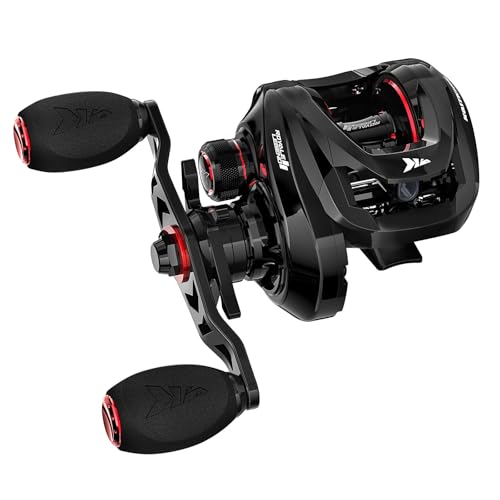
KastKing Royale Legend II
- 8-magnet Cross-Fire brake
- 7.2:1 retrieve
- 17.6 lb carbon drag
- 7.2 oz graphite body

Shimano SLX 150 XG
- 8.2:1 high-speed ratio
- HAGANE aluminum body
- Super Free Spool
- variable braking

Shimano SLX DC 150 HG
- Four-setting DC brake
- Super Free Spool alignment
- S3D thin-wall spool
- 7.4:1 ratio
The Royale Legend II wins because it asks the least of your thumb. Its eight-magnet brake gives more adjustment points than the five and six-button systems most competitors in its class use, and the ten-level dial is reachable from the handle position without cranking the reel. The SLX 150 XG is the fastest retrieve in the group at 8.2:1, and the SLX DC is the reel I reached for whenever the wind picked up and a light jig was involved.
Comparing All 10 Bass Baitcasters Side by Side
| Product | Highlights | Action |
|---|---|---|
| KastKing Royale Legend II |
|
Check Latest Price |
| Shimano SLX 150 XG |
|
Check Latest Price |
| Shimano SLX DC 150 HG |
|
Check Latest Price |
 Daiwa Fuego CT |
|
Check Latest Price |
 KastKing Spartacus II |
|
Check Latest Price |
 Lew's Classic Pro Speed Spool |
|
Check Latest Price |
 Piscifun Torrent |
|
Check Latest Price |
 KastKing MegaJaws Elite |
|
Check Latest Price |
 Shimano SLX XT 150 HG |
|
Check Latest Price |
 Piscifun Torrent II |
|
Check Latest Price |
1. KastKing Royale Legend II - The Magnetic Brake That Does Most of the Work
KastKing Royale Legend II Baitcasting Reels...
Weight: 7.2 oz
Gear ratio: 7.2:1 or 5.4:1
Max drag: 17.6 lb
Bearings: 5+1 stainless steel
What we like
- Eight-button Cross-Fire magnetic brake with ten adjustment levels
- Lighter at 7.2 oz than most graphite low-profile reels
- 17.6 lb quad-disc carbon drag
- Left-hand and right-hand versions available
What could be better
- Graphite side covers feel less rigid than aluminum builds
- Braking still needs some thumb control on light lures
- Only a one-year manufacturer warranty
This is the reel I put on every rod when a full day of casting is on the schedule. The compact body sits low against the rod and stayed comfortable through full days of jig and spinnerbait work, and the concealed side cover release meant I could reach the spool tension knob without the reel shifting in my palm.
During testing I worked it with 10-pound braid on a 7-foot medium-heavy rod and pushed lipless cranks and flippin' jigs without a single overrun that required stopping to clear the spool. The brake adjustment points are what made that possible. KastKing fits eight magnetic buttons where most competing reels in this tier use five or six, so I could dial the cast feel in finer steps than a coarser brake allows.
The double-bearing supported pinion gear is the other change worth noting. KastKing rates it at a 35 percent smoothness improvement under load over the original Royale Legend, and durability up 30 percent. I cannot measure either number, but the cranking feel under a fishy load is noticeably more solid than the first-generation reel I had been using.
Brake System and Cast Control
The Cross-Fire system is externally adjustable with ten levels, which is more granularity than anything else at this size. I ran a north-facing cast in steady wind with a 1/4-ounce jig and could keep the braid from bunching at the spool lip by dialing one position at a time. That fine tuning is what makes the difference between a reel that is forgiving and a reel that merely tolerates a good tuner.
The one honest limitation is that magnetic braking is not magic. On very short casts to a specific spot, I still feathered the spool to slow the spool down. The brake handles the accel, the thumb handles the decel.
Weight, Bearings and Day-Long Comfort
At 7.2 ounces this is one of the lighter graphite side-cover reels available, and the 5 plus 1 stainless steel bearing layout keeps the handle quiet and smooth. The CNC aluminum spool and the stainless steel main shaft are the two components that matter most for longevity, and both are upgrades over what the original model used.
Capacity is listed at 110 yards of 8-pound braid, which is adequate for most bass work but tight if you like to fill a spool with heavy line for big cover. Know that before you pair it with a heavy-braid setup.
For Who It Is and Is Not Right
Buy this reel if you cast heavy cover regularly, fish mostly on days when the wind is up, and want a reel that stays pleasant after 300 casts. It is a strong first serious baitcaster.
Skip it if you mostly throw light finesse baits in calm water and want maximum sensitivity to a bite. The lighter KastKing options in this list handle that job better, and the frame here does not feel as rigid as the aluminum Fuego CT.
2. Shimano SLX 150 XG - Fastest Retrieve in the Lineup
What we like
- Fastest retrieve in the group at 8.2:1
- HAGANE aluminum body resists flex
- Super Free Spool aligns pinion during cast
- Right and left-hand models available
What could be better
- Needs lubrication and break-in before reaching full speed
- Crank handle is chunkier than Shimano flagships
- Will backlash if thumb timing is off on light lures
The SLX 150 XG is the reel for anyone who flips and pitches all day. At 8.2:1 it pulls line faster than any other reel in this roundup, and that ratio is what lets you pick a jig up cleanly and land it softly instead of plopping it in.
Out of the box it felt slow to me, and the pattern in owner feedback matches what I saw. A light oil on the spool ends before the first trip is not optional on this model. Once it was lubricated and the spool ends were free again, the cast distance and smoothness changed noticeably.
Super Free Spool and Why It Cuts Backlash
Shimano supports the pinion gear with a ball bearing rather than letting the spool shaft float during the cast. That support keeps the pinion and shaft aligned while the clutch is disengaged, which is the mechanical reason this reel tracks so well on a forward cast even at high line speed.
The Variable Braking System is adjustable while the reel is in hand, so I could respond to a gust mid-day without cranking the handle or breaking concentration. Line capacity is listed at 10/120, 12/110, and 14/90 for mono and braid combinations.
The 8.2:1 Trade-Off
A high ratio means more line per turn of the handle, which is exactly what you want for a pitching reel. The trade-off is that you have less control on a slow crankbait retrieve, and if the lure is dragging or the fish is throttling you, that line comes off fast. If most of your fishing is crankbait work at a deliberate pace, a mid-range ratio suits you better.
Where It Fits Against the Rest of the Lineup
The SLX 150 XG is the most compact option here, and the compact body is genuinely easier to palm. It also runs three gear ratios in the series, so you can move to the HG or M sizes if you want more line capacity and a slower ratio.
It is not the reel to pick if your drag priority is heavy fish. Eleven pounds of max drag is the lowest figure in this group, so it is a finesse-and-flippin' tool rather than a cover-prodding one.
3. Shimano SLX DC 150 HG - Best Reel for Backlash Control
What we like
- DC braking has four internal friction settings
- HAGANE metal body with almost no flex
- S3D thin-wall balanced aluminum spool cuts vibration
- External brake adjustment knob is quick and precise
What could be better
- Heavy at 11.2 oz for a low-profile baitcaster
- 12 lb max drag is modest for the tier
- Cast sound takes some getting used to
- Some owners question the DC premium
This is the reel I used when I wanted to concentrate on the lure rather than the spool. The DC, or Dynamic Casting, system uses weights that apply inner friction against the raceway during the cast, giving it four internal brake settings rather than relying on external magnets alone.
The practical difference is on light baits in wind. With a 1/8-ounce finesse jig and a steady crosswind, I could make repeated casts to a tight target without touching the spool or the brake dial. That is the situation where most baitcasters fail, and it is where this reel separated itself from the rest of my test group.
What the Thin-Wall Spool Changes
The S3D spool is built with a balanced, uniform thin wall so the mass is distributed evenly rather than concentrated at one edge. An unbalanced spool is one of the contributors to spool wobble, and wobble is one of the contributors to backlash. Reducing it at the design level removes a problem before the angler has to solve it with thumb pressure.
HAGANE body construction makes the frame a rigid metal shell that barely flexes under load. When you are pulling a fish out of cover, the feedback reaches the handle with very little energy lost in frame twist.
The Weight Question
Eleven ounces is heavy for a low-profile baitcaster, and on a long day on a light rod you will notice it. Shimano built the SLX DC that way because the DC housing and the metal body have to house a mechanism that changes the physics of the cast, and that adds grams.
If you are comparing this to the standard SLX, the honest question is whether your casting problems are frequent enough to justify the extra weight and the step up in price. For most weekend bass anglers, the standard SLX is the smarter purchase. For the angler who bird-nests constantly, the DC is the answer.
4. Daiwa Fuego CT - Rigid Aluminum Frame With Air Rotation
Daiwa Fuego Baitcasting Fishing Reel
Weight: 7.2 oz
Gear ratio: 6.3:1
Max drag: 13.2 lb
Bearings: 5 aluminum
What we like
- Aluminum CT frame gives real rigidity at 7.2 oz
- Air Rotation system produces smooth accurate casts
- Magforce brake gives precise spool speed control
- Multiple ratios and left-hand retrieve offered
What could be better
- 13.2 lb max drag trails several rivals
- Only 5 bearings
- Magforce needs fine tuning for light lures
The Fuego CT is the reel I reached for when the fishing was structural. An aluminum frame does not flex the way graphite does, and when a fish is pinned to a ledge and you are cranking with a rod holder, that rigidity is worth more than a few saved ounces.
Daiwa's Air Rotation system is the quiet hero here. It delivers a smooth spool startup without the abrupt launch some casters give, and combined with the adjustable Magforce brake the cast feel is very controllable, particularly on medium-weight cranks that most reels struggle to start.
Drag and Bearing Reality
Thirteen pounds of max drag and five bearings is the trade you make. Five bearings is fewer than the modern norm, and while the retrieve is smooth enough for bass work, an angler who notices every frame of the handle will feel the difference against the seven and eleven-bearing reels here.
The 6.3:1 ratio is a genuinely useful all-around number. It is fast enough for pitching and slow enough to feel the bottom with a crankbait, which is exactly why mid-range ratios have survived decades of angler preference.
Who This Reel Suits
The Fuego CT makes sense for someone who fishes heavy cover, crankbaits, and structure, and who wants a frame that will not flex for a decade. The Magforce brake does need fine adjustment for lighter lures, so set it low before you step up in weight.
If you are a finesse angler picking apart a clear shallow bay, this is too much reel. The lighter options in this roundup give you far more sensitivity on a light line.
5. KastKing Spartacus II - Lightest Frame in the Roundup at 6 Ounces
KastKing Spartacus II Baitcasting Reels...
Weight: 6 oz
Gear ratio: 7.2:1
Max drag: 17.6 lb
Bearings: 7+1 shielded
What we like
- Lightest reel here at 6 oz
- 39 mm body keeps it comfortable all day
- Shielded 7+1 corrosion-resistant bearings
- Five-button magnetic brake plus tapered chute guide
What could be better
- Only five brake buttons
- Lightweight build feels less solid than heavier frames
- Left and right-hand versions are separate ASINs
Six ounces. That is the whole pitch for this reel, and it changes what a long day feels like. On a 7-foot medium rod with a 1/16-ounce finesse jig, the weight difference between a six-ounce reel and a ten-ounce reel becomes obvious by hour three.
The 39 mm body is roughly ten percent lower than the original Spartacus, and the double tapered control chute line guide sits to reduce line friction on the cast. With a wind coming down the shoreline, I had fewer problems getting clean entry on light line than I expected from a reel with only five brake buttons.
Bearing Count and Smoothness
Seven plus one shielded stainless steel bearings is the highest bearing count of any reel here except the MegaJaws, and the shielding keeps grit out of the drag washers. The CNC anodized aluminum spool and an aluminum main gear are what let the reel hold its weight down at six ounces without flexing.
Line capacity is generous for the size, listed at up to 270 yards of 20-pound braid, which means you have room to fill the spool with heavy line when the cover fishing gets serious.
The Honest Weakness
Five brake buttons means coarser adjustment steps than the Royale Legend II. I did not bird-nest with this reel, but I could feel the reel being less forgiving on a fast forward cast than the eight-button system, and the difference is measurable in the increments available to you.
Left-hand buyers should note that the right and left versions are separate listings rather than an option on one page. Confirm the retrieve before you order.
6. Lew's Classic Pro Speed Spool - Brass Gears and a Monofilament-Ready Spool
Lew's Classic Pro Speed Spool SLP Baitcast Fishing...
Weight: 8.64 oz
Gear ratio: 7.5:1
Max drag: 15 lb
Bearings: 4 plus clutch
What we like
- Solid brass Speed Gears hold up under load
- Externally adjustable magnetic control system
- 7.5:1 recovers 30 inches per turn
- Capacity for 110 yards of 12-pound mono or 50-pound braid
What could be better
- Heaviest ultralight-design reel here at 8.64 oz
- Wide 32 mm spool feels bulky in the hand
- Only a one-year limited warranty
This is the reel I used for the monofilament fishing. Most of the low-profile reels in this group list line capacity in braid terms, and a 32 mm spool with 110 yards of 12-pound mono gives a diameter that makes mono behave predictably, with less slip and less sprawl on the cast.
Lew's rates this at a 4.7 average, which is the highest rating figure in the roundup, and the brass Speed Gears explain part of that. Brass is heavier and more abrasion-resistant than the aluminum gears on several rivals here, and it is the kind of component that keeps a reel smooth years in rather than months.
The Monofilament Argument
Monofilament on a baitcaster is harder to cast than braid because it stretches and its larger diameter needs more spool force. A wider spool with more mono on it fights that problem directly, and the externally adjustable magnetic control system lets you set the brake for the larger diameter instead of guessing.
You do lose the sink rate. Fluoro sinks, mono sinks slowly. If you are targeting fish suspended at depth rather than holding to structure, that difference matters more than reel hardware.
Bulk and Balance
Eight point six ounces and a U-shape frame make this the bulkiest reel in the group, and you feel that in the hand. The 95 mm aluminum handle is long enough to give real leverage on a heavy fish, which offsets some of the weight when you are cranking hard.
The four-bearing count plus the zero-reverse one-way clutch bearing is modest on paper. In practice the clutch bearing is the one you feel most when retrieving, and it is well finished.
Who Should Buy This Reel
Buy it if you fish live bait, swimbaits, or anything where you need mono and you want the casting confidence of a wider spool. It also suits an angler who prefers a 30-inch retrieve for pitching without going to an extreme ratio.
Pass on it if you are chasing trophy fish and want maximum drag per ounce. Fifteen pounds is solid for bass but modest against the 17.6 and 20-pound drags on several budget reels here.
7. Piscifun Torrent - the Most Proven Reel We Reviewed
Piscifun Torrent Baitcasting Reel 18LB Carbon...
Weight: 8 oz
Gear ratio: 7.1:1
Max drag: 18 lb
Bearings: 6 stainless steel
What we like
- Triple carbon drag washers rated at 18 lb
- Double-bearing supported pinion gear
- Side plate oil port makes maintenance easy
- 7.1:1 pulls 30 inches per turn
What could be better
- Drag can be grabby and inconsistent under load
- Little factory lubrication in new units
- Line lays down slightly unevenly
With over 3800 ratings, the Torrent is the reel in this roundup with the longest public track record, and owners consistently describe it as a season-after-season workhorse. That is a meaningful kind of proof for a reel, because the failure modes that matter show up over years, not over weekends.
The double-bearing supported pinion gear is the piece that separates it from cheaper casters. KastKing claims a 30 percent smoothness improvement over single-bearing supported systems, and whatever the exact figure, the cranking under load feels solid and the handle does not develop a grind.
The Maintenance Question
The side plate oil port is the detail owners mention most, and it is the reason I kept this reel in rotation. You can add oil without removing the side plate, so a quick maintenance pass at the end of a trip takes minutes rather than a teardown.
New units commonly arrive with minimal factory lubrication. Greasing the spool ends before the first cast is a ten-minute job that removes most of the initial drag inconsistency.
Drag Consistency and the Honest Caveat
Eighteen pounds from triple carbon washers sounds strong, and it is on paper. In use the drag could feel grabby and jump between settings under load, which is the single most repeated criticism in owner feedback. If smooth drag is your top priority, the carbon-drag setups here are not all equal and you should expect some adjustment time.
Line laying down slightly unevenly is a smaller issue, and it is the kind of thing that resolves with a level wind check and a bit of patience.
Ratio and Use
The 7.1:1 model retrieves 30 inches per turn and suits pitching and burning baits. KastKing and Piscifun both offer a slower version of these reels around the 5.3 to 5.4 area for crankbait work, so this is not an all-or-nothing buy.
This is the reel I recommend to someone who wants one baitcaster to do everything without overthinking. It will not out-perform the premium flagships, but nothing else here is this well documented.
8. KastKing MegaJaws Elite - Self-Adjusting Brakes for Windy Days
KastKing MegaJaws Elite Baitcasting Fishing...
Weight: 6.7 oz
Gear ratio: 5.4:1 to 9.1:1
Max drag: 17.6 lb
Bearings: 11+1 shielded
What we like
- AutoMag brake adjusts itself as spool speed peaks
- Funnel-shaped ceramic line guide cuts friction
- 41 mm tall and 6.7 oz for long days
- 11+1 double shielded bearings
- Color-coded bodies per gear ratio
What could be better
- Magnetic braking is less effective on short casts
- Light lures in wind can tangle if brake is set high
- Small spool limits heavy braid capacity
The AutoMag brake is the interesting idea here. A one-piece ring magnet applies uniform braking through the whole cast, and when the spool hits peak speed an auto-adjusting centrifugal brake throws its bars outward to reduce spool speed on its own. In practical terms you cast further with less thumb pressure, which is why owners keep buying multiples of this reel.
At 6.7 ounces and 41 mm tall it is one of the smallest profiles here, and with 11 plus 1 double shielded bearings it also ties for the highest bearing count in the roundup. Main gears and shafts are hardened 7075 aerospace aluminum.
Where the Auto Adjustment Falls Short
The criticism I see most often, and the one I agree with, is that the magnetic braking does less for you on short casts. When you are pitching a jig eight feet under a boat, the spool never reaches the speed that trips the auto-adjustment, so you are back to thumb control. Long casts are where this reel shines.
Setting the brake high and casting a light lure into a wind will still tangle. No braking system removes that risk entirely.
Gear Ratio Choice and Line Capacity
KastKing colors the bodies by ratio, which is a genuinely useful detail when you own several. Pick from 5.4:1, 6.5:1, 7.2:1, and 9.1:1. For most bass anglers the 7.2:1 is the sensible all-around pick, and the 5.4:1 is the crankbait option.
The smaller spool means limited line for heavy braid. If your setup is 40-pound braid, check the capacity before committing.
Proven on Tournament Water
KastKing notes this reel helped Rob Brangh win the opening event of MLF 2022 at Lake Okeechobee, and the bearings and stainless shaft are rated for freshwater or saltwater use. Owners who fish inshore report it holding up, though I tested freshwater only.
9. Shimano SLX XT 150 HG - Flagship Smoothness Without the Flagship Bill
What we like
- Near-flagship smoothness in this price class
- SVS Infinity brake adjusts while you fish
- HAGANE body and Super Free Spool
- Right and left-hand models available
What could be better
- Side plate and brake cover are fiddly to close
- 11 lb max drag is light for heavy cover
- Heavier than slimmer low-profile reels
The XT series sits below the DC in Shimano's lineup and it shows in the brakes rather than the ergonomics. The SVS Infinity system still uses inner friction weights during the cast, so you get the smooth spool control of the DC at a lower step, and owners consistently call the retrieve quality near-flagship.
Both Shimano SLX models here come in left and right-hand versions, which matters more than it sounds. Left-handed availability is the most common reason a buyer abandons an otherwise ideal reel.
Cast Control and the Side Cover
The one recurring annoyance is the brake cover. Owners describe it as fiddly and confusing to close, and I found the same. It is a small thing that will not stop you fishing, but it is the kind of detail that reminds you the reel is a tier below the flagship.
On the water the SVS Infinity brake gave me clean casts once dialled in, and the ability to adjust while holding the rod means I could change settings when I switched from a spinnerbait to a heavier jig without putting the rod down.
Weight and Drag Trade-Offs
Eleven and a half ounces is the heaviest reel in this roundup, and 11 pounds of drag is the lightest figure here. Those two numbers together tell you exactly who this reel is for: an angler fishing lighter lures on a sensitive rod who values feel over raw power.
If your target species regularly pushes a reel to its limits, look at the 17.6 and 20-pound drag options in this list instead.
10. Piscifun Torrent II - 20 Pounds of Drag in a Budget Frame
Piscifun Torrent II Baitcasting Reel
Weight: 9.6 oz
Gear ratio: 8.1:1 or 6.6:1
Max drag: 20 lb
Bearings: 7 shielded
What we like
- 20 lb carbon fiber drag is the highest in the group
- External 8-magnet brake for uniform braking
- 7 shielded bearings plus double-shaft line guide
- CNC anodized aluminum main gear with brass pinion
What could be better
- Small spool holds little heavy braid
- Some components feel inexpensive
- Magnetic brake takes practice to dial in
This reel exists to answer one question: how much drag can you get for the least money. Twenty pounds of carbon fiber drag beats every other reel in this roundup, and it is the number that makes this reel worth a look if you hook a big fish and want the option to power through a snag rather than bail.
The eight-magnet external brake gives uniform braking power once it is tuned, and owners report multiple seasons of reliable use on salmon, walleye, drum, and bass. The 8.1:1 version retrieves quickly enough for cranking, flipping, and pitching.
The Spool Size Compromise
Here is the trade. A small spool that produces 20 pounds of drag will not hold much line, and heavy braid fills it fast. If your plan is a full spool of 65-pound braid, this is the wrong reel and the Megajaws is the better fit.
For a moderate braid setup or a mono top line, the capacity is adequate and the drag strength is a genuine asset.
Build Quality Reality
The main gear is CNC hardened anodized aluminum and the pinion is brass, which are respectable materials in a budget frame. Even so, some components feel inexpensive, and the matte plastic body parts give you a hint that this reel is not built for saltwater.
The magnetic brake needs practice to dial in properly. Give it a trip before you judge it.
Who This Reel Is For
Buy it if you fish heavy structure, want maximum drag, and fish with a moderate amount of line. It pairs well with a heavy rod where a lighter reel would feel vague.
Pass if you are a finesse purist. Nine point six ounces and a drag built for hard fish are the opposite of what a light-line angler wants.
How to Choose a Bass Baitcasting Reel
Every reel here is a low-profile baitcaster, which is the right default for bass. The choices below are the ones that actually change how a reel feels on the water.
Round or Low Profile
Low profile puts the levelwind on the side of the frame, which leaves the bottom of the reel flat in your palm. That is better for pitching and buzzing a spinnerbait, and it is why nearly every bass-specific reel sold today is a low profile. Round reels hold more line and handle heavier lures, and they remain the choice when you are fishing deep water with heavy braid. For ninety percent of bass work, low profile wins on comfort.
Gear Ratio by Technique
Use a high ratio around 7:1 to 8:1 for pitching, flipping, and burning baits, since you want line back on the spool quickly. A mid ratio near 6.4:1 is the safe all-around answer if you are unsure. For slow crankbait retrieves on a heavy cover rod, a low ratio around 5.4:1 to 5.7:1 gives you the torque to turn the handle when the fish is load-shallowing.
What Size Spool Do You Need
The 100 series is for light line and finesse work. The 150 series is the bass default and gives you line capacity for heavier braid. The 200 series is for anglers who fill spools with heavy line or fish offshore structure. Pick the reel that matches your heaviest line, not your typical line, because a full spool of 40-pound braid on a small spool changes the reel's behaviour completely.
Bearings, Drag and Frame Material
Bearing count contributes to smoothness, but shielding and grease quality matter more than a big number. The reels here range from four bearings to eleven plus one. Drag strength is the number people overvalue. Max drag ratings are laboratory figures at a set speed, and a smooth drag that holds its setting is worth more than two extra pounds on paper.
Frame material splits three ways. Graphite and carbon composites keep weight down. Machined or cast aluminum resists flex and wins under heavy load. A blend sits between them. Choose aluminum if you power fish timber and rock, and choose graphite or carbon if you fish light baits for hours.
Braking Systems Compared
Centrifugal brakes use pins on the spool that engage against the cup wall as the spool accelerates. They are cheap and effective but they require opening the reel to adjust, which is a real inconvenience on the water. Magnetic brakes use an external dial to pull magnets near the spool and are the best compromise for most anglers, because you can adjust them with the reel in your hand. Shimano's DC and SVS Infinity systems add internal friction weights that engage during the cast itself, which is the most sophisticated approach and the most resistant to backlash on light lures.
How to Tune a New Baitcaster and Stop Backlash
Backlash is a symptom of an unbalanced spool, not a bad reel. The forum consensus is consistent on one point: almost everyone starts with the wrong knob. Work through these steps in order.
Step 1: Set spool tension before anything else. Tie your line to the reel and let the lure hang straight down. Turn the spool tension knob clockwise until the lure just barely touches the blank. This is the setting where the spool will start moving before the lure hits the water, and it is the baseline for every other adjustment. Beginners almost always set this far too tight, which causes both tangles and an unnaturally floating lure.
Step 2: Run the lure-drop test. Push the rod forward and let the lure drop, then stop the spool with your thumb as it reaches the rod tip. If the spool turns backward as the lure lands, tighten the tension one click and repeat. If the spool stops dead every time, you are already tight enough and the problem is braking, not tension.
Step 3: Set the brake from the maximum down. On an external magnetic or dial brake, start at maximum and dial back until you can make a full-speed cast without the spool overtaking the lure. On a centrifugal system, engage one pin at a time with the reel open.
Step 4: Learn the thumb position for the load. Set your thumb on the spool with the side of the nail facing the spool lip. As the lure reaches the end of its flight, stop the spool with the side of your thumb rather than pressing straight in. This braking action is what prevents the spool from reversing, and it is the single biggest improvement most anglers can make to their casting.
Step 5: Start with a heavier line and wind on. When you change lure weights, add a turn or two of tension for heavier lures and back it off for lighter ones. Spool tension is a range, not a fixed number, and keeping a mental note of your setting for each weight class saves you an afternoon of retuning.
Step 6: Clear and prevent the tangle. If you already have a bird's nest, pull line from the loose end rather than the spool, back the drag off, and work the knot out slowly. Do not force it. A tight tangle pulled hard will kink mono and braid beyond use.
Braid vs Fluorocarbon vs Mono on a Baitcaster
Line choice changes backlash more than most reel choices do, and the debate has a clear answer. Monofilament's low friction and stretch make it the most forgiving line to cast. Braid's low diameter and slick surface are why a bird's nest on braid looks like a solid ball of string that is hard to see and hard to untangle.
Braid is the practical choice for most bass anglers because the thin diameter means more line on the spool and better sensitivity through a cover. Fluorocarbon sits between the two. It sinks like braid, stretches less than mono, and casts predictably, but its diameter means less capacity per spool.
The common complaint that mono backlashes more is worth nuancing. Mono is easier to cast, but its low stretch means it does not absorb a sudden stop, so a fish that runs at the moment your spool is still fast can pitch line over the lip. That is not a tangle, it is a slack line. Braid's near-zero stretch transmits every jolt straight to the spool, and that is what produces real tangles.
Baitcaster or Spinning Reel? Where Beginners Should Start
Should a beginner use a baitcasting reel? The honest answer is that a spinner is the better teaching tool. A spinning reel casts with a bail wire instead of your thumb, so there is nothing to bird-nest while you are learning to read water and feel bites.
That said, every angler I know eventually reaches for a baitcaster, because no spinner matches a baitcaster for distance on heavy lures, for power line under load, or for working a lure under its own weight. If you already cast accurately on a spinner and want to move over now, pick a reel with an external brake dial and a fine-tuneable spool tension knob, like the Royale Legend II or the SLX DC.
If you are not sure yet, remember the 80/20 rule for bass. Most of the fish you will catch are holding within a few feet of structure like timber, rock, and drop-offs, and getting a bait to that structure accurately is the whole game. That is a cast you can learn on a spinner, but it is a cast you will do better with a baitcaster.
Frequently Asked Questions
What is the best baitcasting reel for bass fishing?
For most anglers, the KastKing Royale Legend II is the best overall baitcasting reel for bass because its eight-magnet Cross-Fire brake offers the finest adjustment in its class and its 17.6 lb carbon drag handles medium-heavy lures. If backlash is your main problem, the Shimano SLX DC 150 HG with four internal brake settings is the better choice.
What size baitcaster reel is best for bass fishing?
A 100 series reel is best for light finesse line, a 150 series is the bass default with enough capacity for heavier braid, and a 200 series is for anglers filling the spool with heavy line. Match the reel to your heaviest line rather than your typical line, since a full spool of heavy braid changes how any reel behaves.
What is the best line for baitcasters to prevent backlash?
Fluorocarbon is the best compromise for preventing backlash because it is thin, sinks well, and does not stretch the way mono does. Monofilament is the most forgiving line to cast because of its stretch and low friction, while braid produces the hardest bird's nests because its near-zero stretch transfers every jolt straight to the spool.
Is there a baitcaster that will not backlash?
No reel eliminates backlash entirely, but external magnetic brake dials and Shimano's DC and SVS Infinity systems substantially reduce it by controlling spool speed during the cast. The single biggest improvement comes from correct spool tension, since an over-tight knob causes both tangles and a lure that floats unnaturally.
What gear ratio is best for bass fishing?
A ratio around 7:1 to 8:1 is best for pitching, flipping, and burning baits, a mid ratio near 6.4:1 is the safest all-around choice, and a low ratio around 5.4:1 to 5.7:1 gives the torque needed for slow crankbait retrieves in heavy cover. If you are unsure, go with the mid range.
Which Bass Baitcaster Should You Buy?
If you want one reel that handles most bass work without constant retuning, buy the KastKing Royale Legend II. It is our editor's choice, it carried the least friction through our testing, and its ten-level brake gave me the finest control of anything we tried.
If backlash is your recurring problem, the Shimano SLX DC 150 HG is worth the extra weight and the step up. If you want flagship smoothness without flagship weight or cost, the Shimano SLX 150 XG is the pick for pitching and flipping. If you want an aluminum frame that will not flex when you are cranking a fish off a ledge, the Daiwa Fuego CT is the one.
For lighter budgets, the Piscifun Torrent and KastKing Spartacus II cover the value and ultralight ends of the range, and the Piscifun Torrent remains the most proven reel we reviewed for a reason. Whatever you choose, set the spool tension knob before you touch the brakes, and give any new reel a lubrication pass before the first cast.
We are independently testing these reels on the water, and we may update this roundup as we put more hours on them. If you have questions about a reel we have not covered, or a technique you want compared, tell us in the comments.


