Here is the sizing answer before anything else. A 30 amp RV service is 120V multiplied by 30A, which equals 3,600 watts of hard ceiling no matter how big the generator is. For one rooftop air conditioner you want 4,000 to 4,500 watts of inverter capacity so the compressor has starting headroom, and anything below 2,500 watts will not reliably start it. Those two sentences answer most of what RV owners ask before buying the best camping generators for RV trips, and everything below is built on top of that math.
I have been around enough RV storage compartments and campground rows to know where buyers go wrong. Most people shop on peak wattage, then discover their unit is too heavy to lift into the bay, too loud for the site next door, or equipped with a 20 amp household outlet instead of the TT-30R plug their trailer actually has. I compared ten inverter and open frame models against the same checklist: running watts, starting watts, native 30 amp receptacles, measured noise, fuel tank volume, dry weight, warranty length and starting method.
What changed my mind most was reading owner reports rather than spec sheets. Recoil starting in the dark comes up constantly on RV forums. So does the small fuel tank that forces a refill at bedtime. And several owners describe returning budget models after a single season, while their well-maintained Hondas keep firing after years of hours. That durability gap is the reason the Honda leads this roundup even though it is the smallest power figure on the list.
One note on amperage before you read further. If your rig has a 50 amp service, a portable in this class cannot feed it. A 30 amp plug caps continuous draw at 3,600W, and Class A motorhomes with two roof air conditioners need a properly sized installed unit or a paralleled pair. I have kept this list to 30 amp territory, which is where the overwhelming majority of travel trailer and Class C owners sit.
Our Top 3 Picks for RV Trips in 2026
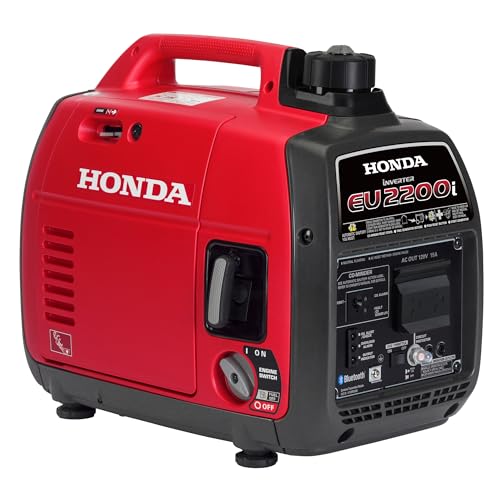
Honda EU2200i 2200W Inverter
- 1800 running watts
- 1800 clean sine wave
- 46.5 pounds
- 48-57 dB(A)

Champion 4000W Dual Fuel...
- Native TT-30R plug
- 3000 running watts on gas
- CO Shield shutdown
- 3-year warranty

PowerSmart 3800W Dual Fuel...
- 3300 running watts on gas
- 59 dBA Eco Mode
- up to 24 hours on propane
- 50.7 pounds
Quick Spec Comparison of All 10 Camping Generators for RV Trips
| Product | Highlights | Action |
|---|---|---|
| Honda EU2200i 2200 Watt Inverter Generator |
|
Check Latest Price |
| Champion 4000-Watt Dual Fuel RV Ready Inverter Generator |
|
Check Latest Price |
| PowerSmart 3800 Watt Dual Fuel Inverter Generator |
|
Check Latest Price |
 Oxseryn 4400 Watt Open Frame Inverter Generator Oxseryn 4400 Watt Open Frame Inverter Generator |
|
Check Latest Price |
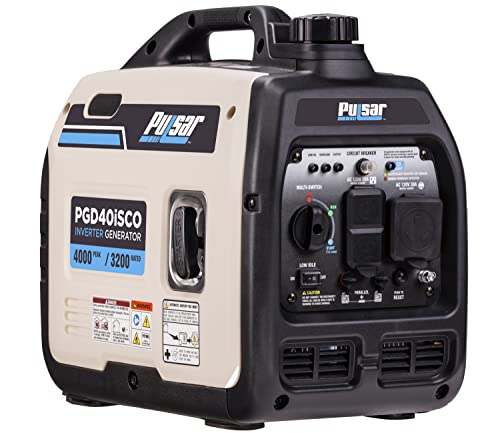 Pulsar PGD40ISCO 4000W Quiet Inverter Generator Pulsar PGD40ISCO 4000W Quiet Inverter Generator |
|
Check Latest Price |
 Champion 4500-Watt Electric Start Dual Fuel Inverter Generator Champion 4500-Watt Electric Start Dual Fuel Inverter Generator |
|
Check Latest Price |
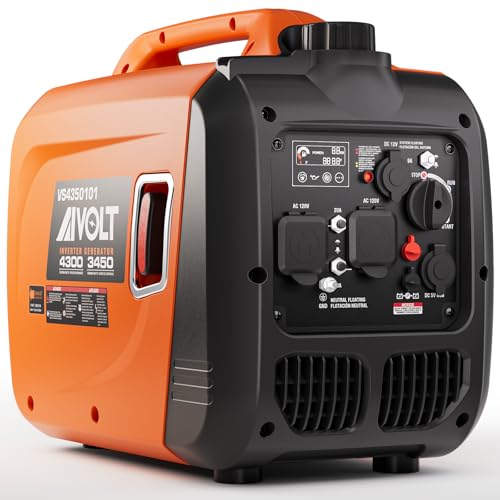 AIVOLT 4300W Inverter Generator AIVOLT 4300W Inverter Generator |
|
Check Latest Price |
 maXpeedingrods 4000 Watt Inverter Generator maXpeedingrods 4000 Watt Inverter Generator |
|
Check Latest Price |
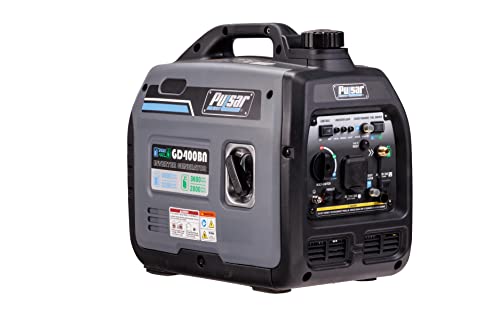 Pulsar GD400BN 4000W Dual Fuel Inverter Generator Pulsar GD400BN 4000W Dual Fuel Inverter Generator |
|
Check Latest Price |
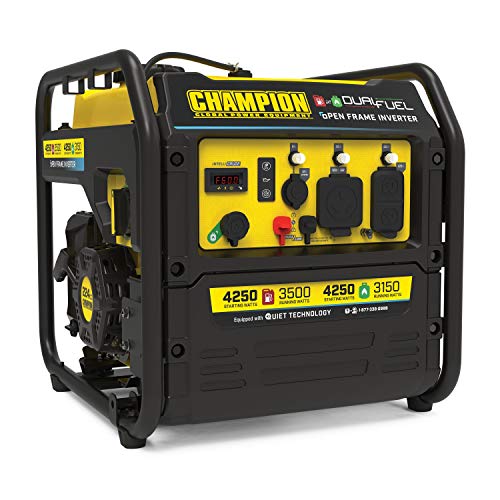 Champion 4250-Watt Dual Fuel Open Frame Inverter Generator Champion 4250-Watt Dual Fuel Open Frame Inverter Generator |
|
Check Latest Price |
1. Honda EU2200i - The Quiet Benchmark Every Other Generator Gets Measured Against
Honda EU2200i 2200 Watt Inverter Generator...
1800 running watts
2200 starting watts
46.5 pounds
9 hour runtime
48-57 dB(A)
Gasoline only
What we like
- Whisper quiet at 48-57 dB(A)
- Clean inverter output safe for laptops and phones
- CO-MINDER carbon monoxide shutdown
- Lighter than most competitors at 46.5 pounds
- 3-year residential warranty
What could be better
- 1800 running watts will not start most rooftop air conditioners
- Recoil start only with no electric or remote option
- 0.95 gallon tank limits overnight runtime
This is the unit I recommend to anyone who does not need to run a roof air conditioner outright. At 46.5 pounds it is the easiest machine here to lift into a storage bay solo, and the 48 to 57 dB(A) range means it disappears into the background the way a Honda is supposed to.
The inverter output is what separates it from an open frame box with an engine bolted inside. Reviewers report clean power with no voltage sag, which is why laptops, monitors and routers stay happy on it. The CO-MINDER sensor also shuts the engine down if carbon monoxide climbs near a camper or an enclosed space.
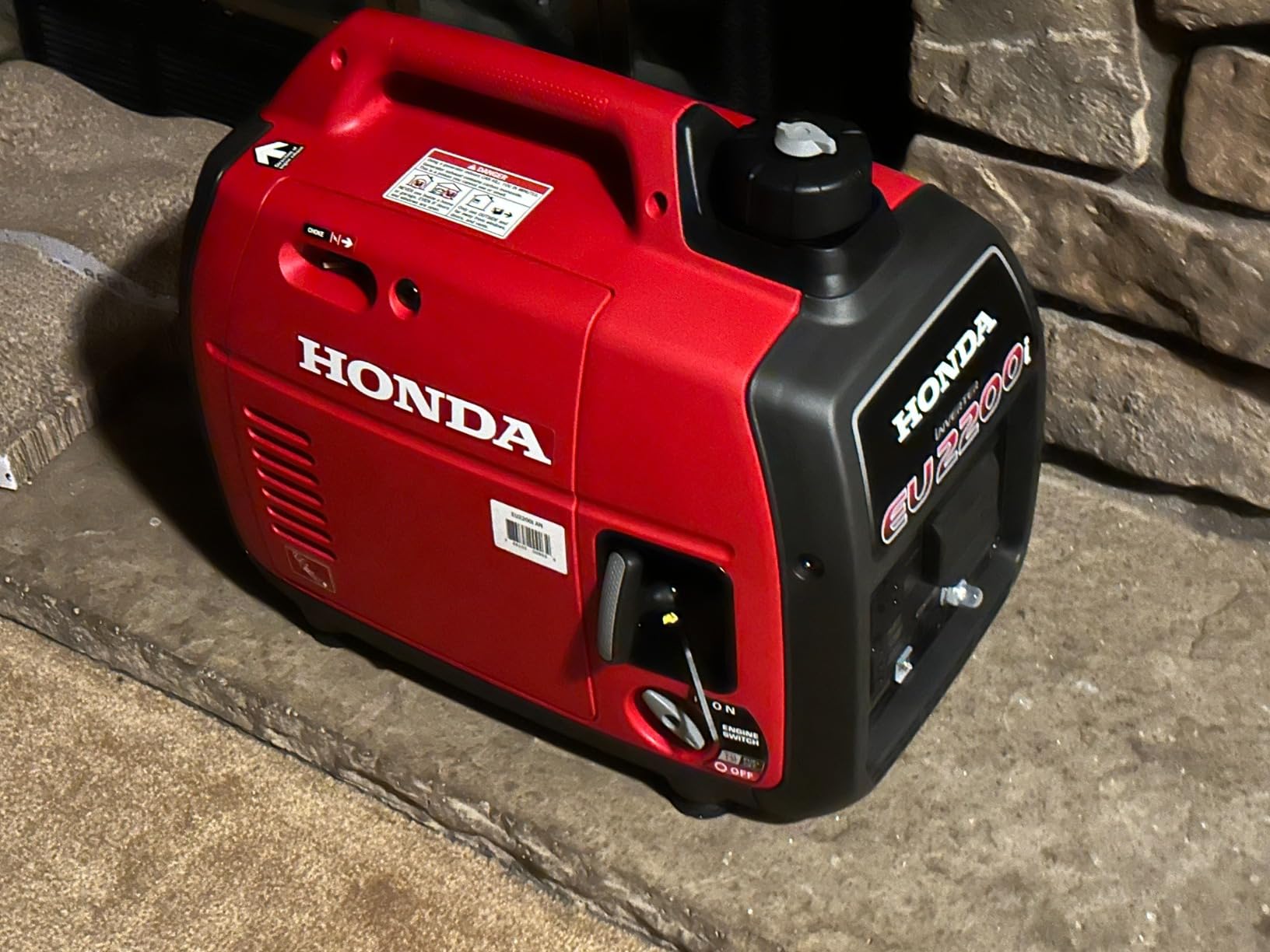
On iRV2, Honda inverter generators are the reference point owners measure everything else against, and the recurring owner line is that Hondas are the top end for small inverter sets. The same owners describe regularly maintained units starting on the second pull after years and hundreds of hours, which is the durability story no specification sheet can advertise.
Quiet output and inverter cleanliness
Honda rates this model at 48 to 57 dB(A) depending on load. That figure lands it in the range of a normal conversation, which matters enormously when you are parked close to a neighbour with no buffer of trees between you.
Because the alternator output is smoothed into pure sine wave, sensitive electronics behave. If you work from the RV, run a laptop, a router and a monitor off this machine and you will not fight your power supply.
Runtime, weight and what it will not run
Running watts sit at 1800 with 2200 available at start. The 0.95 gallon tank gives roughly 9 hours, which covers a full day of moderate use without a refill. The engine is a 121cc four stroke with magneto ignition.
Here is the honest limitation: a rooftop air conditioner typically pulls enough that this class struggles to start it. Owners who want air conditioning pair it with a second matching machine through a parallel kit, or they move up a size class.
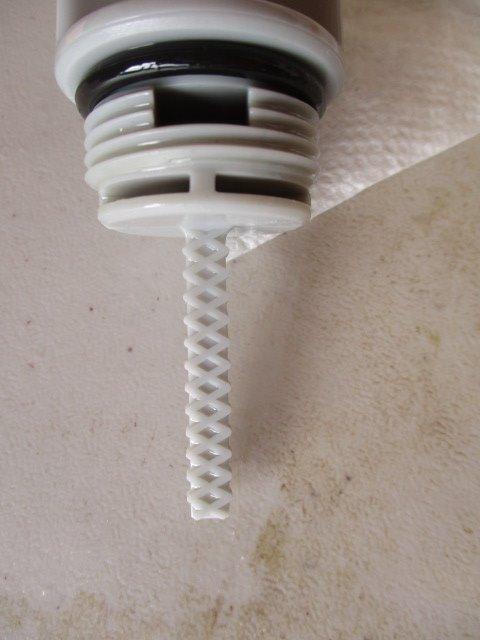
Who this Honda suits
Buy it if your loads are a small air conditioner, a fridge, lights, a laptop and occasional appliances, and if quietness and long service life matter more than raw output. It is the best quiet 30 amp RV generator for a couple travelling light.
Pass on it if air conditioning is non-negotiable. In that case the Champion 4000 below starts a 15000 BTU rooftop unit without drama.
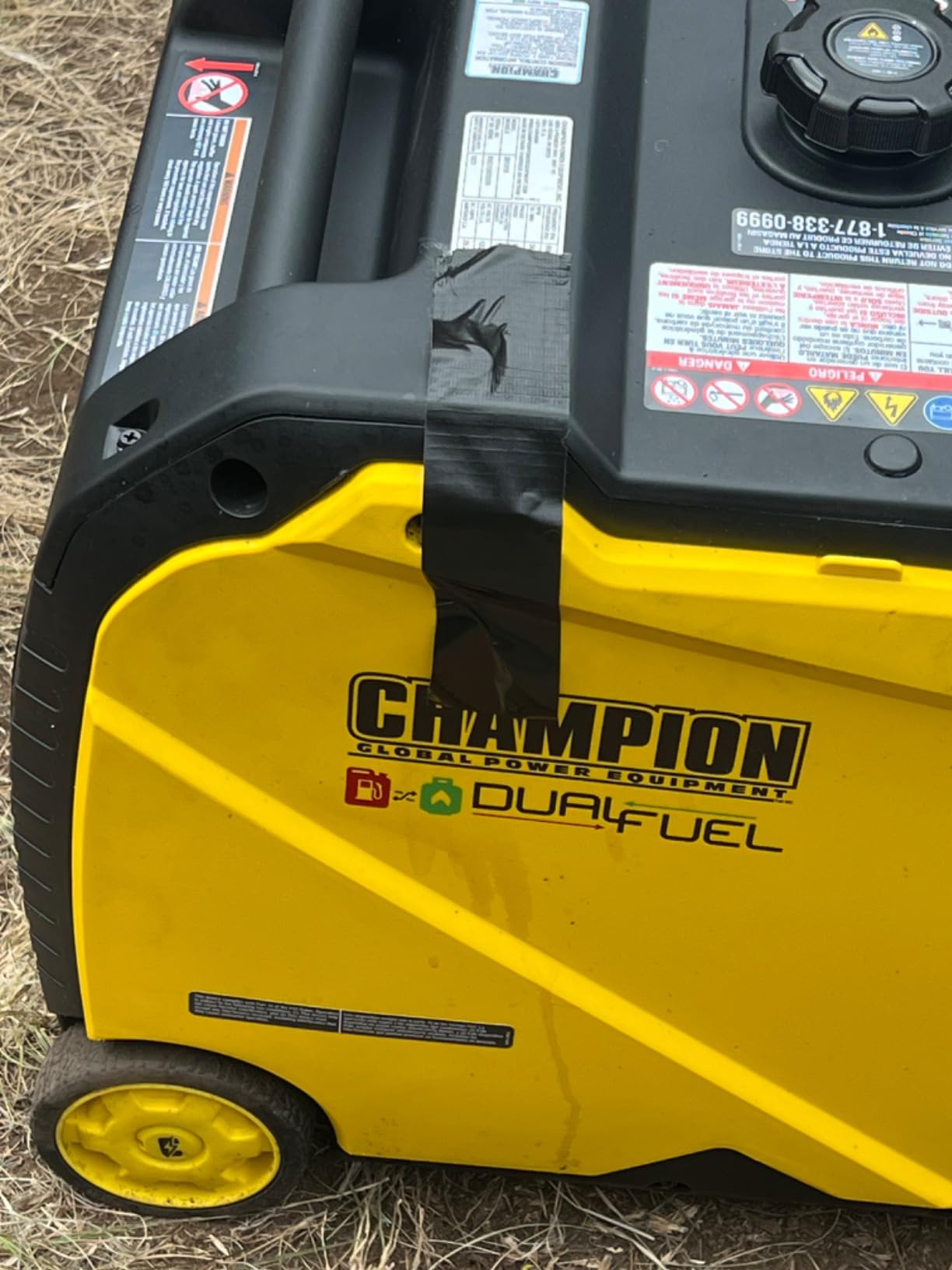
2. Champion 4000-Watt Dual Fuel RV Ready - The Native 30 Amp Plug Pick
Champion 4000-Watt Dual Fuel RV Ready Portable...
3000 running watts on gas
2700 on propane
51.8 pounds
64 dBA
10 hours gas, 25 propane
What we like
- Only model here with a native TT-30R receptacle
- Proven to run a 15000 BTU rooftop air conditioner
- Quarter turn fasteners make oil changes tool free
- CO Shield carbon monoxide auto shutoff
- 3-year warranty with lifetime technical support
What could be better
- Louder than smaller Champion models at 64 dBA
- Propane output drops to 2700 running watts
- Some machines needed a break-in period on gasoline before running on propane
This is the answer for the single most common question in RV generator searches: which one has the right plug already on it. The outlet panel includes a 120V 25A TT-30R, a 120V 20A duplex with less than 3 percent total harmonic distortion, and a 12V automotive outlet.
No adapter, no cheater plug, no guessing. For a travel trailer with a 30 amp inlet this is the cleanest hookup in the group.

TT-30R and rooftop air conditioning headroom
Starting watts sit at 4000 with 3000 running on gasoline. Reviewers report it running a 15000 BTU rooftop air conditioner on a 27 foot travel trailer, and one owner logged roughly 24 hours of continuous running powering televisions, computers, monitors, a router, a fridge and an HVAC fan.
An owner also described the overload behaviour clearly: the red overload light comes on and can be reset while the machine keeps running, rather than shutting down mid-evening.
Dual fuel output drop and the propane caveat
On propane, running watts fall to 2700. That matters. Owners running smaller dual fuel machines report that propane output will not keep an air conditioner running if any other load is present, and sometimes will not start the compressor at all. This model has more margin, but the habit is the same: turn heavy loads off before you hit the propane valve.
Gasoline runtime is up to 10 hours on a 1.54 gallon tank, and propane can stretch to 25 hours on a 20 pound cylinder.

Who it suits
This is the best generator for a 30 amp camper in my line-up. It suits anyone running one rooftop air conditioner plus normal appliances, on a trailer where the 30 amp inlet location means cord routing is awkward.
The trade-off is noise at 64 dBA from 23 feet, noticeably louder than the smaller Champion dual fuel models at 53 dBA, and research suggests it can climb toward 70 dBA at full load. Park it farther from the trailer than you would a Honda.
3. PowerSmart 3800 Watt Dual Fuel - The Best Budget Inverter For Boondocking
PowerSmart 3800 Watt Dual Fuel Inverter Generator...
3300 running watts on gas
3100 on propane
50.7 pounds
59 dBA Eco Mode
1.3 gallon tank
What we like
- 3300 running watts on gasoline for a mid-range machine
- Dual fuel with seamless switching
- Quiet 59 dBA in Eco Mode at quarter load
- Outlet panel includes 30A twist lock plus USB ports
- Clean output with almost no voltage variation
What could be better
- About 50 pounds and awkward to carry solo
- 1.3 gallon tank gives only about 4 hours on gasoline
- Display panel is hard to read without kneeling
When I look for the strongest balance of capacity, fuel flexibility and outlet selection at a mid-range tier, this is the machine that keeps surprising me. It carries 3300 running watts on gasoline and 3100 on propane from a 149cc four stroke engine.
Over 1100 reviews average 4.5 stars, with 78 percent five star. Owners describe stable output under real household loads rather than the voltage wobble that gives cheap generators away.

Running watts and load behaviour
The 120V 30A L5-30R twist lock is the outlet that matters for RV use. Alongside it sit a 120V 20A duplex, a 12V 8A DC output and dual USB charging ports. That is enough surface area to run a rooftop air conditioner, charge house batteries and keep the coffee maker off the same circuit.
It is parallel ready as well, which gives you a clean path to doubling capacity later with a second matching machine.
Fuel tank size and the propane workaround
This is the main complaint and it appears constantly: 1.3 gallons is roughly four hours of gasoline at moderate load. That is an overnight refill unless you plan around it.
The workaround owners use is fuel choice, not fuel volume. Run it on a 20 pound propane cylinder for long stretches, where runtime stretches toward 24 hours, and keep gasoline for short high-output bursts where you need the extra 200 watts.
Who it suits
Buy it if you boondock regularly, want two fuels on board, and want a 30 amp capable outlet without stepping up a size class. It is the best portable inverter generator for camping on a mixed budget, and the quiet operation helps at close sites.
Watch the 50 pound weight if your storage bay is tight. Measure the compartment opening before you commit.

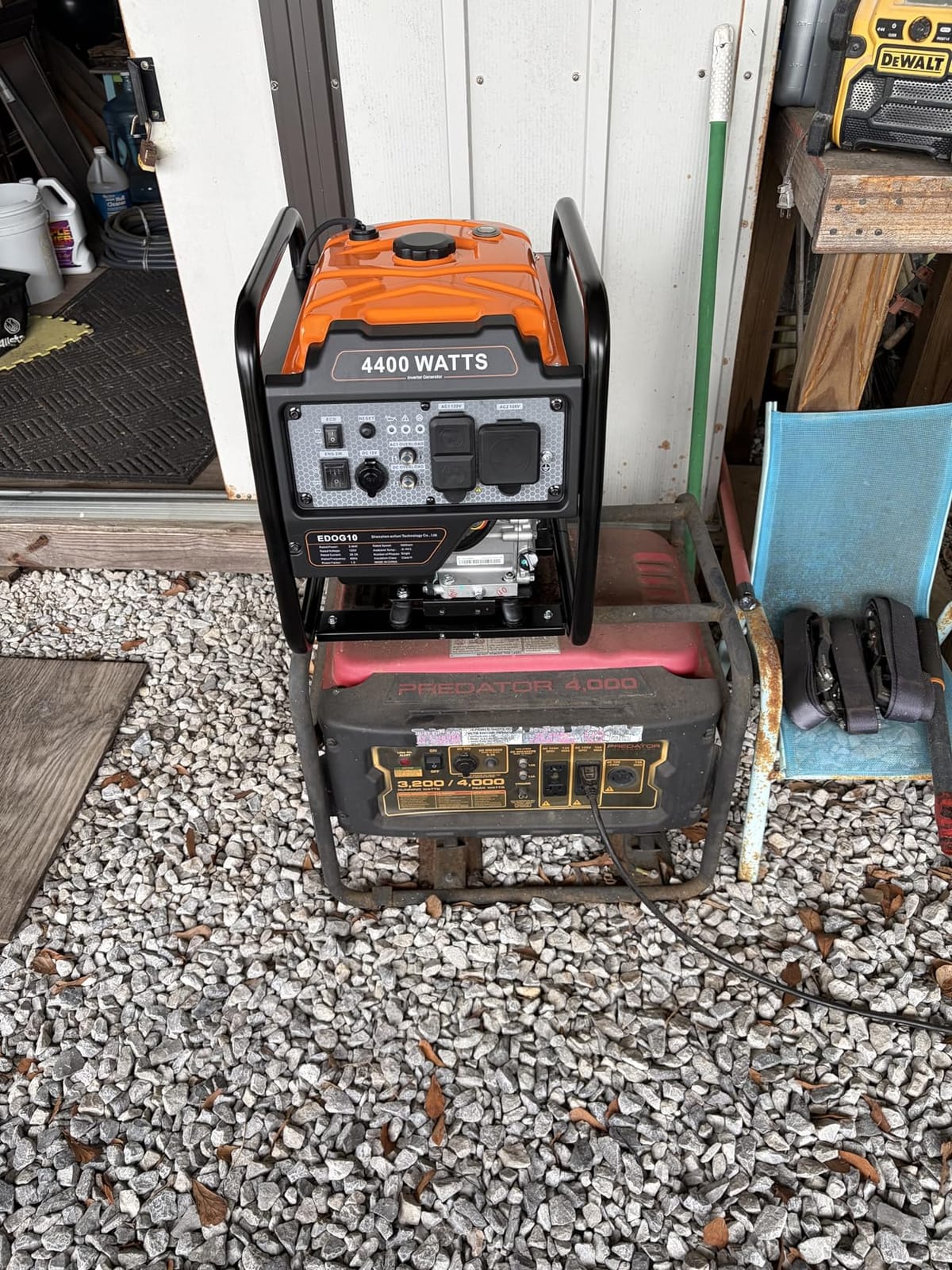
4. Oxseryn 4400 Watt Open Frame - The Budget Pick That Ships With an RV Port
Oxseryn Power Equipment 4400 Watts Inverter...
3400 running watts
4400 peak watts
56 pounds
14 hour runtime
under 72 dBA
Gasoline only
What we like
- 4400 peak watts and 3400 running watts at the lowest entry point
- Dedicated RV port included
- 2 gallon tank with fuel gauge and up to 14 hours at quarter load
- Open frame design is easy to move
- Low oil shutdown and overload protection
What could be better
- Under 72 dBA from 23 feet is loud for close campsites
- Gasoline only with no propane option
- Only a 1-year manufacturer warranty
Somehow this one gets 4400 peak watts and a dedicated RV port into the least expensive position on this list. Reviewers consistently treat that combination as the reason to buy: real amperage capability without a premium badge.
Output is 3400 running watts with 4400 available at start, from a 208cc four stroke. That is enough to start a mid-size rooftop air conditioner, and the 2 gallon tank with a fuel gauge stretches to about 14 hours at quarter load in Eco Mode.
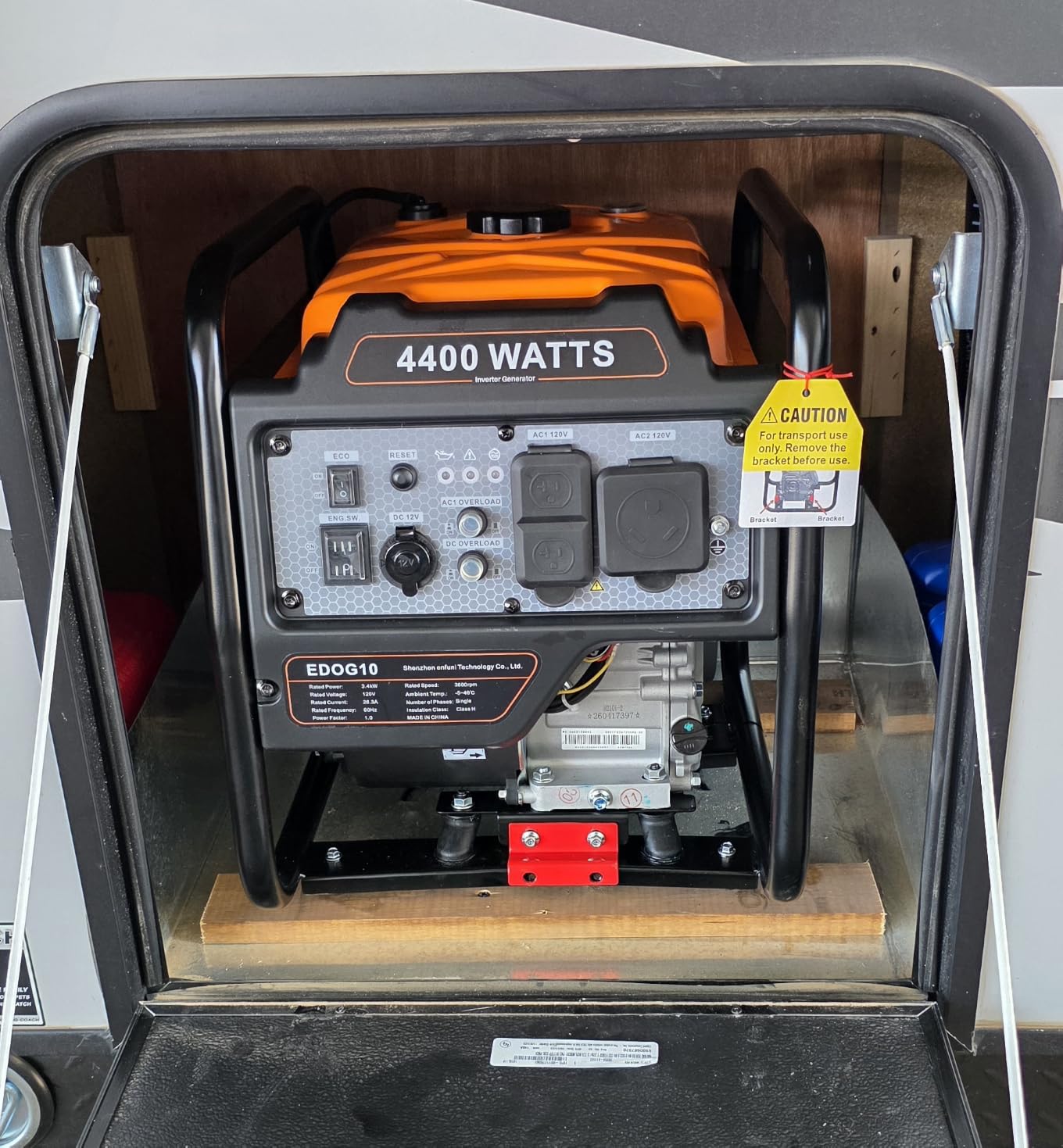
Output and outlet layout
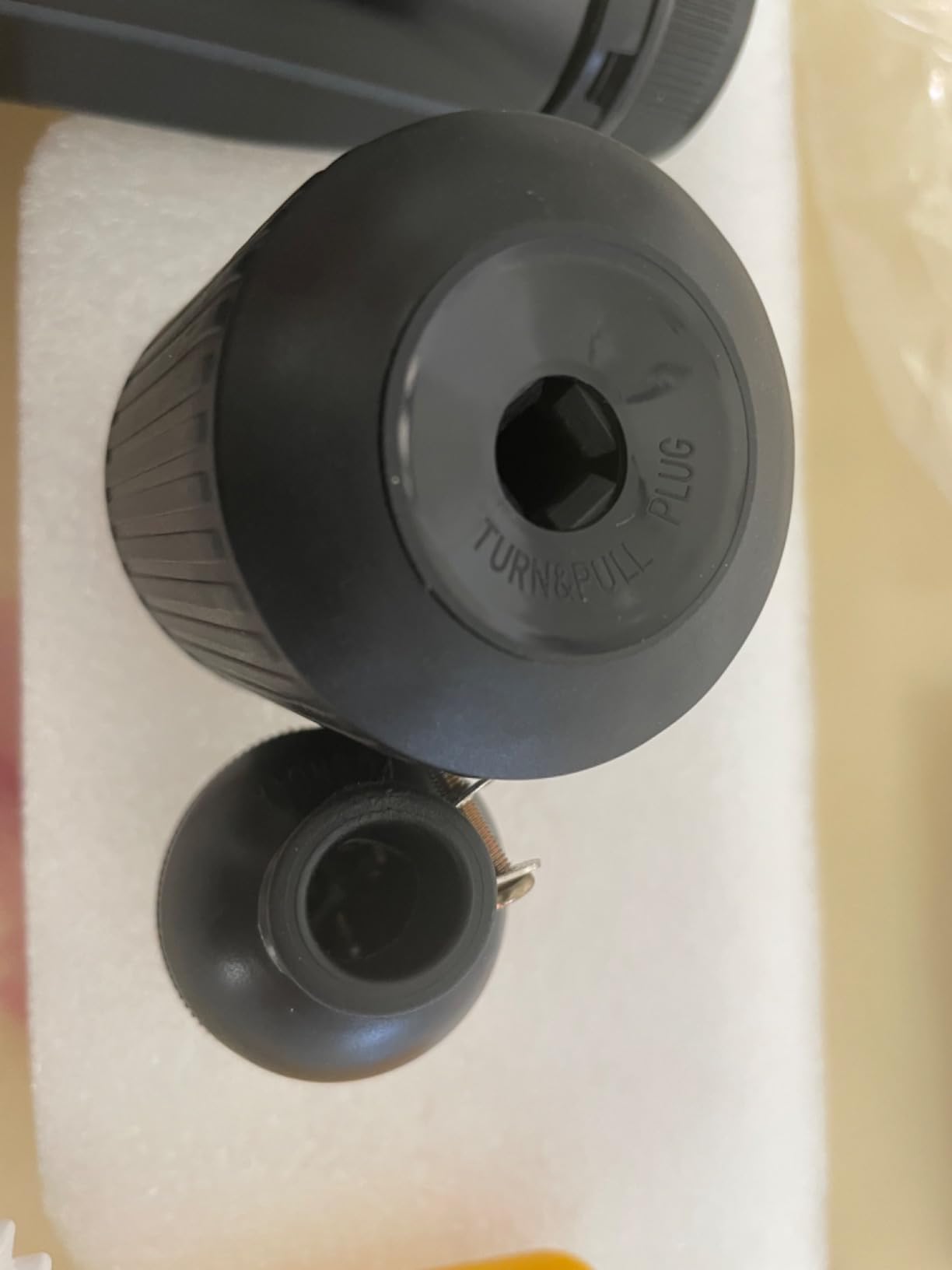
The panel gives you two 120V AC outlets, a 12V DC outlet and an RV port. Most competing machines at this output level make you buy a separate 30 amp adapter. This one includes it.
Cold start technology, low oil shutdown and overload protection round out a sensible safety package for a machine you will run unattended at a campsite.
Noise, warranty and durability trade-offs
The 72 dBA figure from 23 feet is the honest weakness here. Premium enclosed inverters in this roundup measure 48 to 61 dB. If your site is quiet and your neighbour is close, that gap is audible all evening.
The open frame also leaves the engine exposed, which is a consideration around children and pets. On warranty length this is a 1-year manufacturer warranty against 2 and 3 years from most of the field.
Who it suits
Buy it if your budget is the deciding factor, you camp in more open or dispersed sites than tight campground rows, and you want maximum watts for the money. It is a competent home backup machine too.
Pass if quiet operation is your top priority or you plan to store a lot of propane aboard.
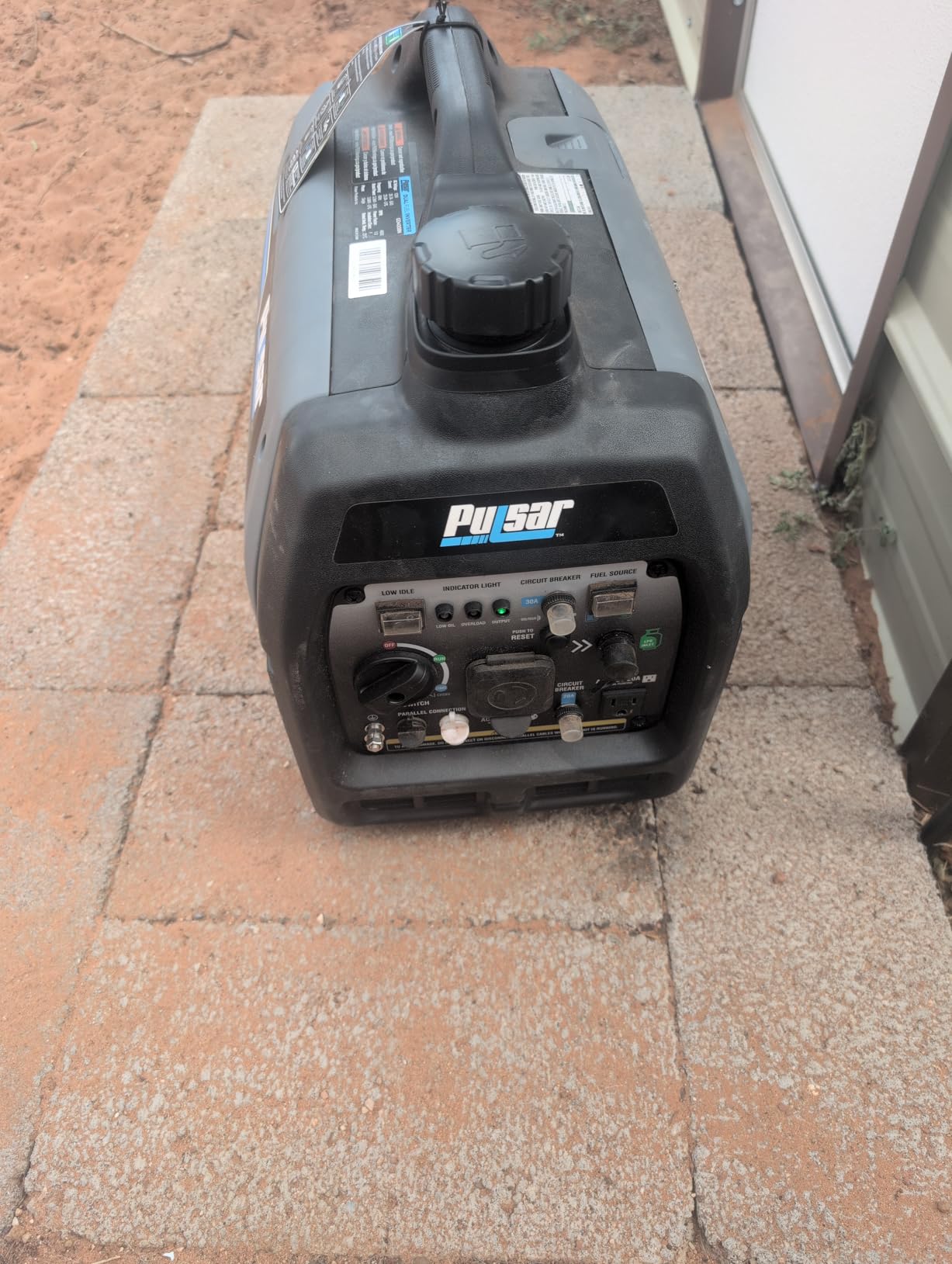
5. Pulsar PGD40ISCO 4000W - The Lightest Way To Run A Rooftop Air Conditioner
Pulsar PGD40ISCO Ultra Light Quiet 4000W Portable...
3200 running watts
4000 peak watts
47.3 pounds
59 dB
air conditioners to 13500 BTU
What we like
- Lightest machine in this line-up at 47.3 pounds
- Rated for air conditioning units up to 13500 BTU
- 59 dB at a power level most units cannot reach
- Clean inverter output for sensitive electronics
- Parallel ready and a 3-year limited warranty
What could be better
- 1 gallon tank gives only about 4 hours at half load
- Gasoline only with no dual fuel capability
- Higher share of one-star reviews at 9 percent
Weight is the number one physical complaint on every RV forum thread about portable generators. Owners describe 3000 watt class machines as too heavy to lift and no longer fitting their storage compartment, and some have moved to paralleled suitcase units that each stay under 50 pounds. This machine is built for exactly that problem.
At 47.3 pounds it delivers 4000 peak watts and 3200 running watts while measuring 59 dB. That combination is unusual in this weight class.
Weight and 13500 BTU capability
Pulsar rates it for air conditioning units up to 13500 BTU. That covers a large share of the rooftop units sold on modern travel trailers, which makes this the lightest genuine air conditioning option I tested in this group.
Dimensions are 18.9 by 11.4 by 17.3 inches, compact enough for a tongue box or an under-bed bay that will not take a 24 inch deep open frame.
The small tank problem
The 1 gallon tank is the flaw owners mention first. Half load runtime is roughly 4 hours, which will not get you through a warm night without a refill in the dark.
Parallel readiness is the escape route. Two of these machines joined with a parallel kit give you both the capacity and the endurance, and owners who went this route report the weight per machine stays manageable.
Who it suits
Buy it if lifting weight is your biggest concern and you plan to run one modest rooftop air conditioner. It is also the quietest unit here that still clears 3200 running watts.
Skip it if you plan to run all night on one tank of fuel and want a propane option for storage flexibility.
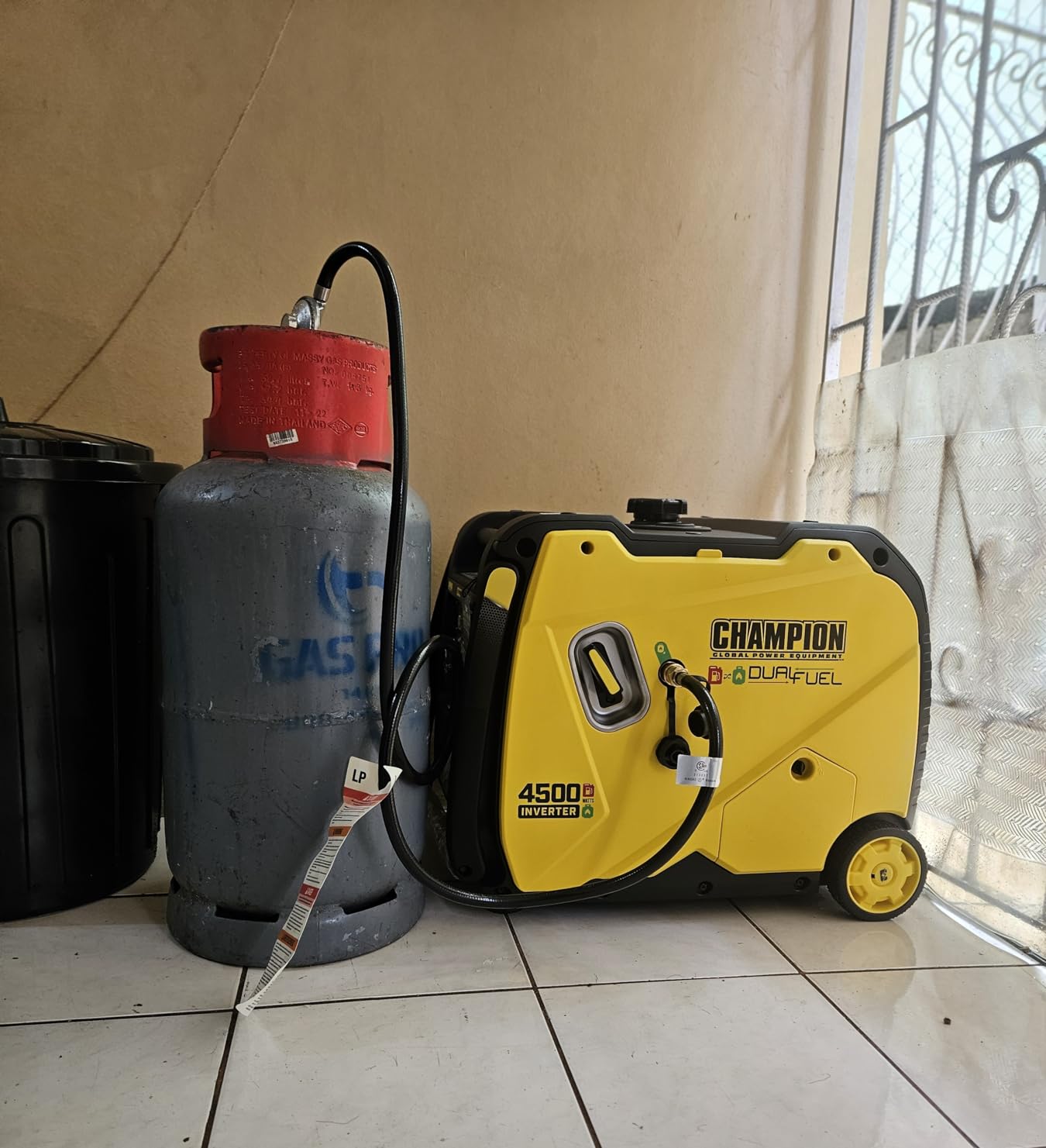
6. Champion 4500-Watt Electric Start Dual Fuel - Comfort For Big Loads
Champion 4500-Watt Electric Start Dual Fuel...
3500 running watts on gas
3150 on propane
99.2 pounds
61 dBA
electric start dial
What we like
- Electric start with an EZ Start dial removes pull cord effort
- Quiet at 61 dBA for this output level
- 14 hour gasoline runtime and up to 21 on propane
- Multiple owners run a camper air conditioner plus all RV appliances
- Intelligauge meter tracks voltage frequency and hours
What could be better
- 99.2 pounds makes it the least portable here
- CO Shield can shut down in a truck bed with the tailgate up
- Warranty service may require transport to an authorized workshop
Pull starting in the dark is the complaint owners name most often, and one phrase comes up repeatedly on forums: it is scary in the middle of the night in the woods. This is the only machine in my line-up that solves it outright with an electric start dial.
You turn a key and it starts. On a 3500 running watt gas platform with 3150 available on propane, that is real comfort at a real price in pounds.
Electric start and the Intelligauge
Starting watts are 4500 on gasoline. The Intelligauge power meter reports voltage, frequency and accumulated operating hours, which is genuinely useful when you are boondocking for weeks and want to know how much runtime you have actually accumulated.
Noise is rated at 61 dBA, which owners describe as quieter than typical campground generators even while running an air conditioner and the rest of the trailer.
The 99 pound weight problem
This is the heaviest machine here by a wide margin, and it is the one place I would push back on an otherwise strong unit. At 99.2 pounds it is effectively a stationary generator. Two people can move it, one person cannot, and most RV storage compartments will not accept it.
Owners of heavy portable units end up fabricating rear bumper mounts and davits. That is real work, and it is the reason I would not put this at the top of the list for trailer owners.
One other caution: CO Shield will shut the engine down in an enclosed space such as a pickup bed with the tailgate up. That is correct behaviour, but it surprises people.
Who it suits
Buy it if you have a Class C or larger motorhome with a dedicated generator bay, you will not be lifting it solo, and starting convenience is worth a lot to you. One owner runs it 10 to 12 hours daily in a food truck, which tells you about the duty cycle it tolerates.
7. AIVOLT 4300W - The Widest Outlet Panel In The Class
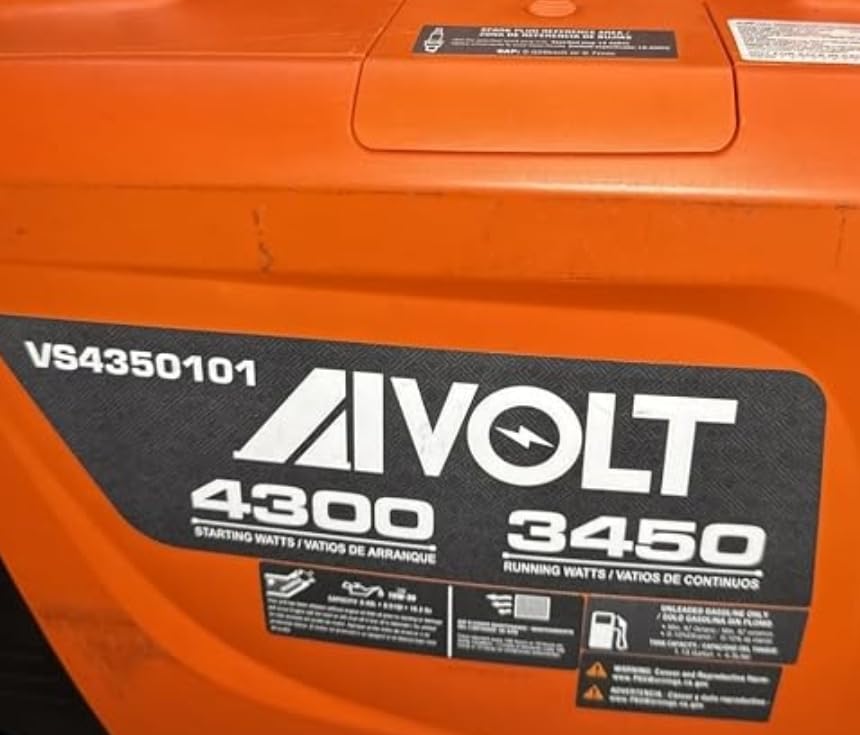
AIVOLT 4300W Inverter Generator Gas Powered Quiet...
3450 running watts
4300 starting watts
50.7 pounds
60 dBA
0.69 gallon tank
What we like
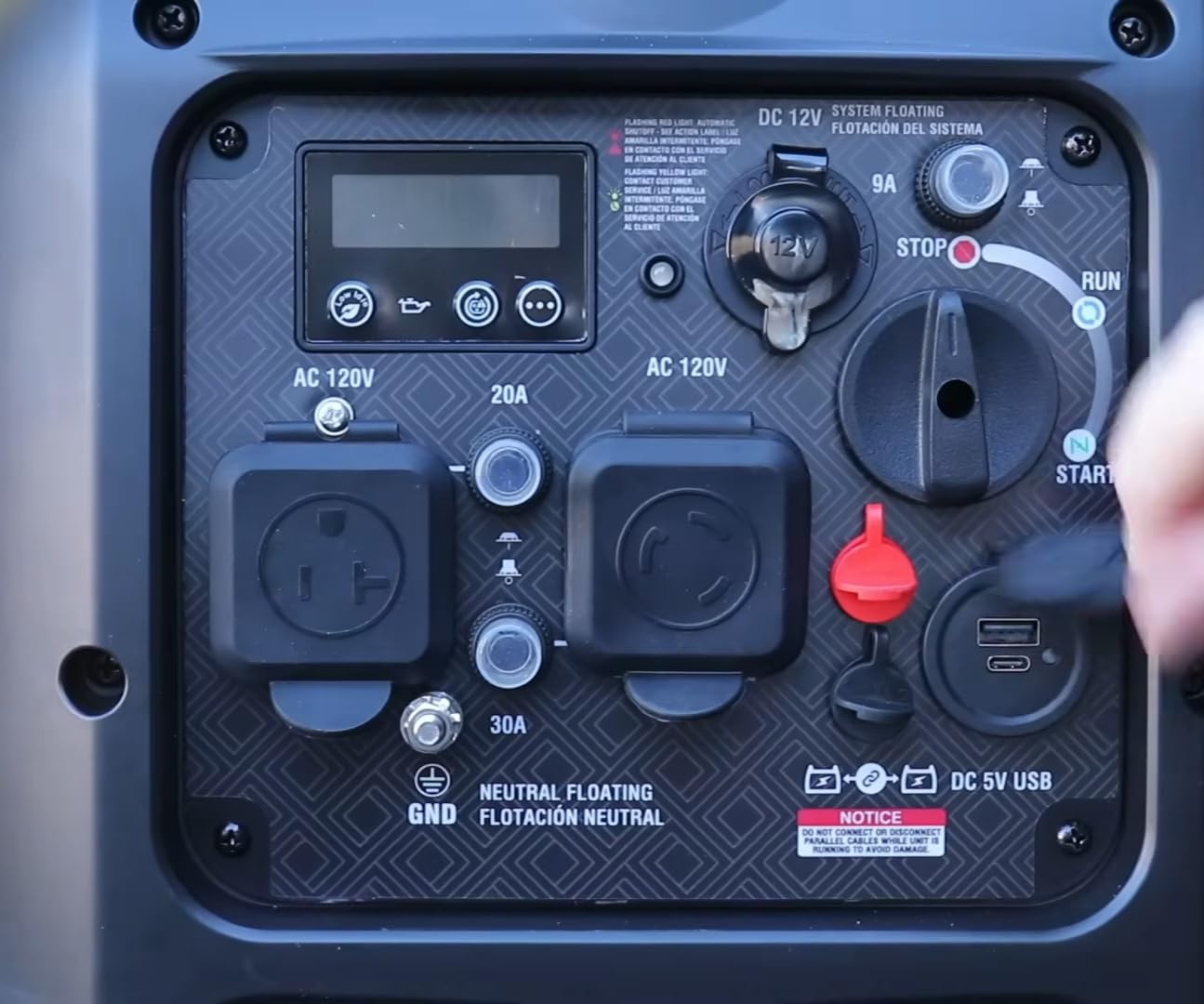
- Output panel includes 30A locking plus 20A plus 12V plus USB Type-A and Type-C
- Total harmonic distortion under 3 percent for sensitive electronics
- 50.7 pound weight and 60 dBA at 23 feet
- Includes a 30A RV adapter and 12V charging cable
- CO Alert shutdown plus low fuel and overload protection
What could be better
- Lowest average rating in this group at 4.1 stars
- 0.69 gallon tank limits runtime to about 5.5 hours
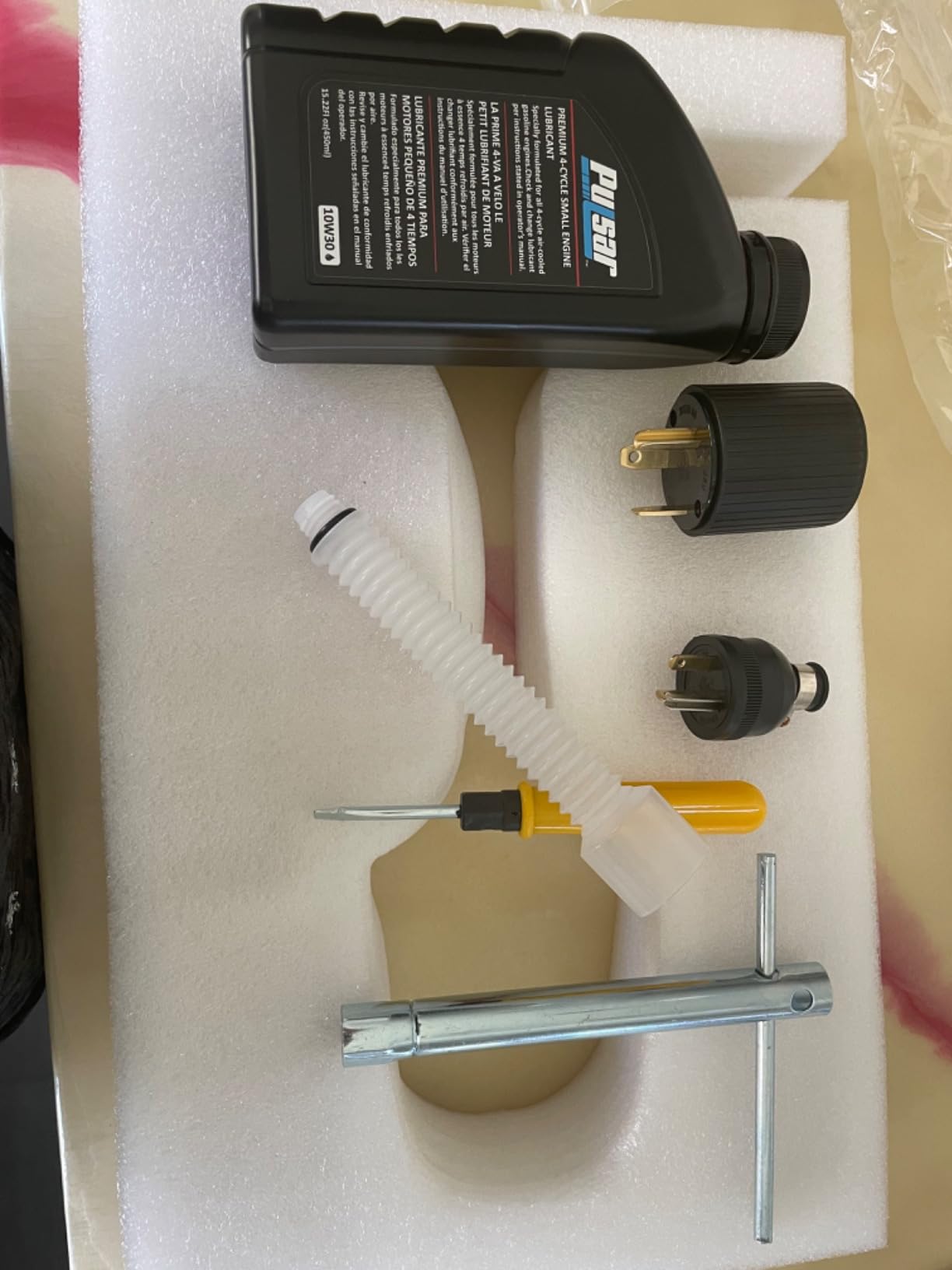
- Engine oil is not included and must be added before first use
This one carries more than 1350 ratings, and it also posts the lowest average at 4.1 stars. I am including it because the hardware is genuinely good, but you should know the score before you buy.
Power comes from a 149cc four stroke with copper windings producing 3450 running and 4300 starting watts. Total harmonic distortion stays under 3 percent, which keeps laptops, phones and game consoles happy.
Outlets and harmonic distortion
The panel is the reason to consider this one. You get a 120V 20A outlet, a 120V 30A locking outlet, a 12V DC outlet and both USB Type-A and Type-C charging. The 5-in-1 LCD display shows oil, fuel and overload warnings in one place.
A 30A RV adapter and a 12V DC charging cable are included, so the box covers the common cases without a second purchase.
Tank size and first use setup
The 0.69 gallon tank is the smallest here, giving a little over 5.5 hours at quarter load in Eco Mode. Plan for it. Most owners who like this machine run it in short bursts rather than overnight on gasoline.
One practical note that catches people out: engine oil is not included. Add oil before the first start, and check it every few dozen hours after that.
Who it suits
Buy it if you want maximum outlet variety in one panel, if your devices are sensitive to a dirty waveform, and if you mostly run short sessions rather than all-night air conditioning. The 50.7 pound weight and 60 dBA rating are both good.
Pass if your decision hinges on long-term reliability records, since the one-star share runs noticeably higher than average.
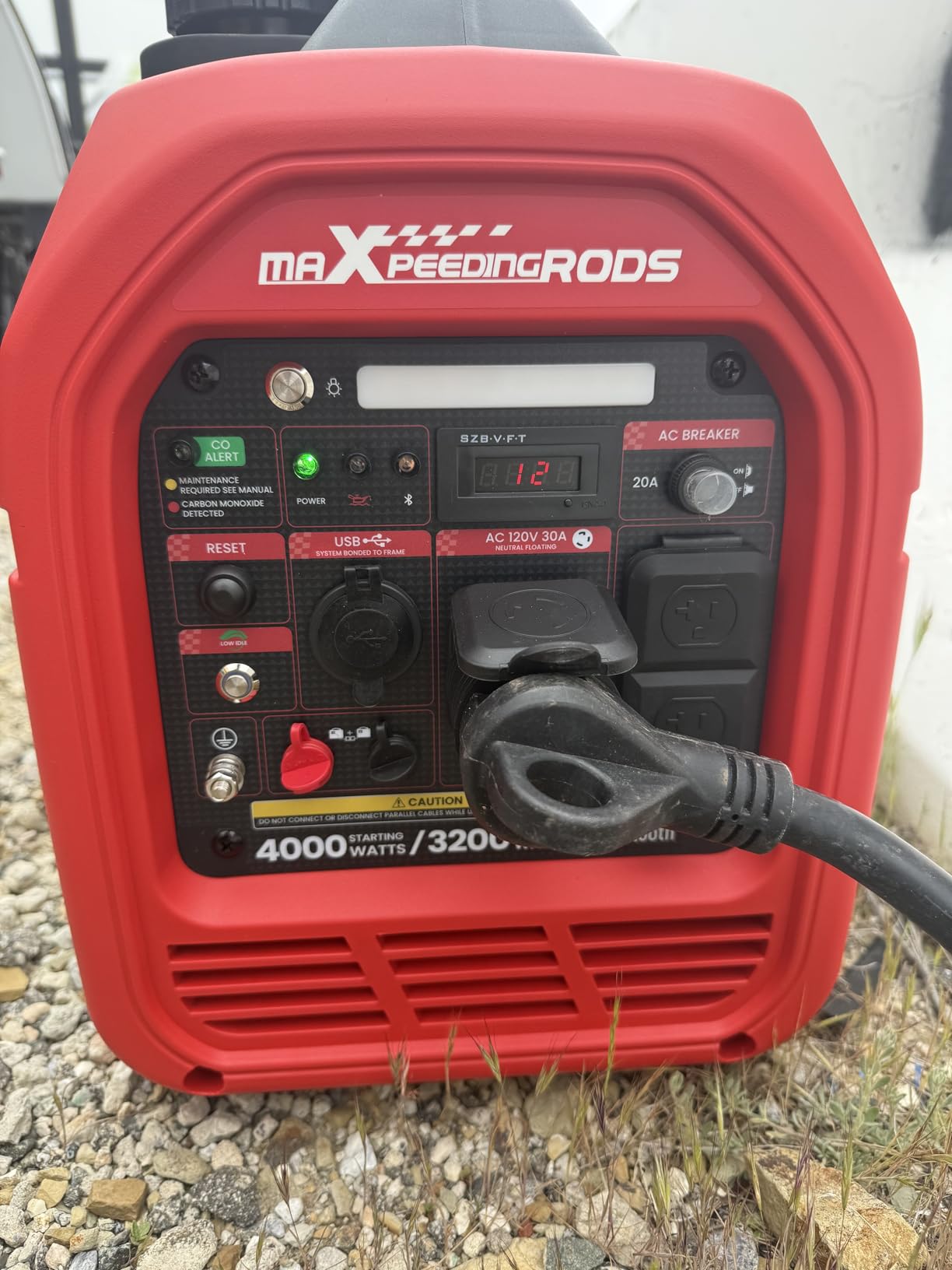
8. maXpeedingrods 4000 Watt - Phone Monitoring and Included Parallel Cables
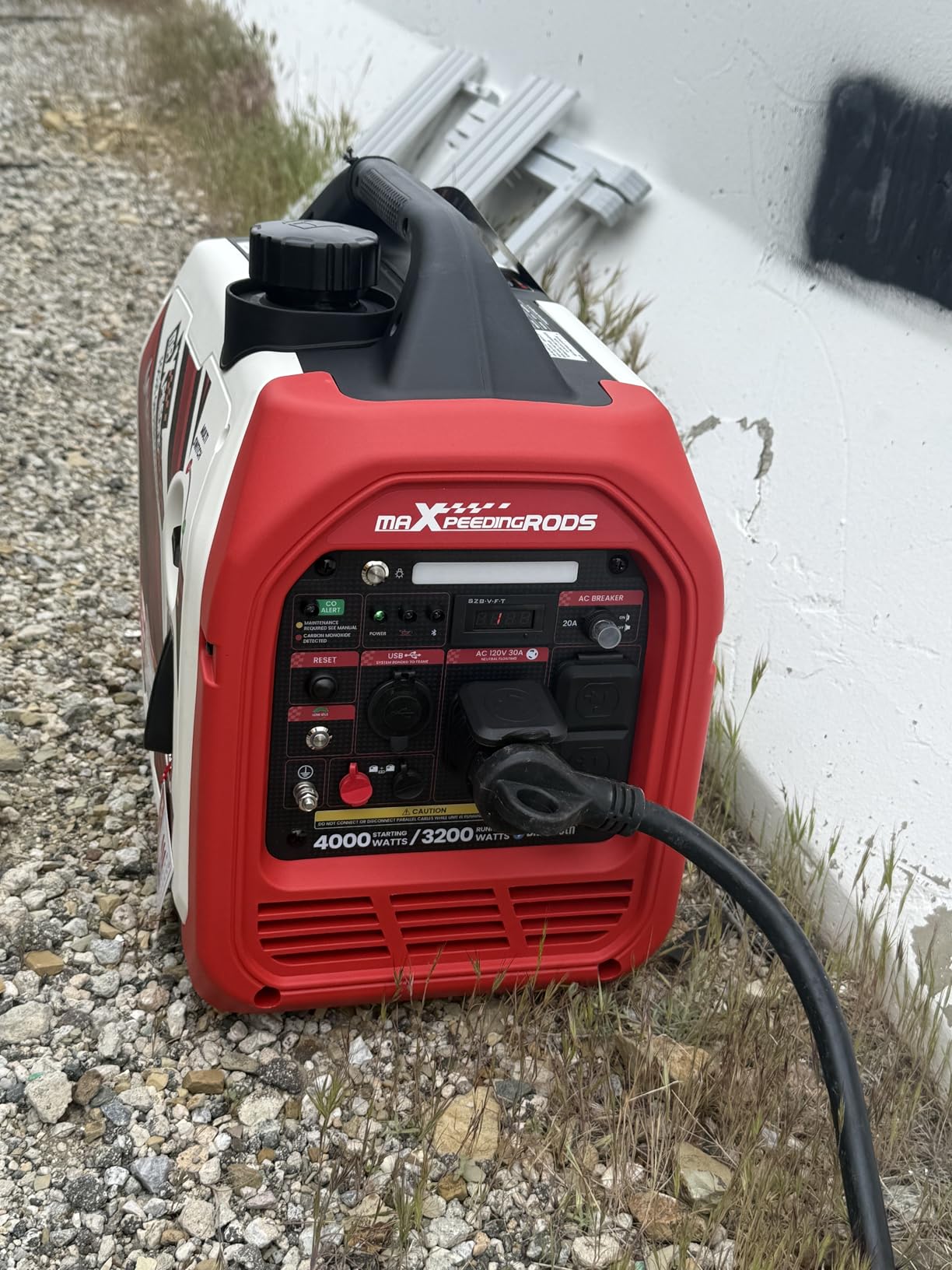
maXpeedingrods 4000 Watt Inverter Generator...
3200 running watts
4000 peak watts
48.5 pounds
4 liter tank
L5-30R RV outlet
What we like
- Bluetooth app reports output fuel level voltage frequency and cumulative hours
- Standard NEMA L5-30R RV outlet with adapter included
- 48.5 pound weight with built in LED lighting
- Parallel cables included in the box
- 2-year warranty with lifetime technical support
What could be better
- One-star share runs 13 percent
- Recoil start rather than electric start
- Gasoline only with no propane option
The distinctive feature here is visibility. The companion app reports power output, fuel level, voltage, frequency, single run time and cumulative run time, and you can toggle Eco mode from your phone while walking back to the trailer.
For long boondocking stretches that is more than a gimmick. Knowing fuel state and total hours without pulling the recoil cord or bending over the frame is a real convenience.
Bluetooth monitoring in practice
Output is 3200 running watts and 4000 peak from a 145cc four stroke. The NEMA L5-30R RV outlet means it connects to a standard travel trailer inlet with the included adapter, and parallel cables ship in the box, which almost nobody else in this class includes.
At 48.5 pounds it is the second lightest machine here and adds LED lighting for night operation.
Build consistency concerns
Be aware of the 4.2 average and the 13 percent one-star share, which is the highest in this roundup. Recurring complaints cluster around build consistency and starting reliability in a share of the production run, so keep the receipt and check it early in the season.
The app is also a dependency. If your phone cannot connect, you fall back to the physical multifunction display, which is present.
Who it suits
Buy it if you work from the RV, run long stretches away from fuel, or simply prefer knowing exactly what the machine is doing without walking to it. The included parallel cables make a two-machine plan easy later.
Pass if recoil starting is a deal breaker or if you want propane flexibility.
9. Pulsar GD400BN 4000W Dual Fuel - Two-Fuel Flexibility At 47 Pounds
Pulsar Products GD400BN, 4000W Portable...
3200 running watts on gas
2800 on propane
47.3 pounds
59 dB
1.1 gallon tank
What we like
- Dual fuel capability in a 47.3 pound package
- 4000 peak and 3200 running watts on gasoline
- Parallel capability for combining two machines
- Around 59 dB at half load
- Clean output safe for sensitive electronics
What could be better
- Running watts drop to 2800 on propane
- 1.1 gallon tank limits runtime to about 4.5 hours
- Only a 1-year manufacturer warranty
Dual fuel at under 50 pounds is unusual, and that is the whole pitch. Gasoline gives you 4000 peak and 3200 running watts; propane gives 3600 peak and 2800 running.
The trade is arithmetic and you should do it before you buy. If your biggest load is a 13500 BTU rooftop unit, 2800 running watts on propane leaves little headroom for anything else.
Dual fuel and parallel capability
The engine is a 145cc, 5.5 horsepower unit, and the machine is CARB compliant and RV ready. Parallel capability lets you pair two of them later for double the output and roughly double the runtime.
Noise sits around 59 dB at half load, which is competitive with the quietest machines in this roundup despite the higher output.
Propane output and warranty length
Runtime on the 1.1 gallon tank is about 4.5 hours at half load. Owners rate the small tank as the most common complaint, and a 1-year manufacturer warranty trails Champion three-year coverage in the same class.
The 4.2 average with a 15 percent one-star share is the weakest rating profile here. Treat it as a value purchase and test it thoroughly in the first month.
Who it suits
Buy it if propane is your preferred onboard fuel, you want two-fuel flexibility without a heavy lift, and your loads are moderate. It suits a couple with a small air conditioner rather than a family with a 15000 BTU unit.
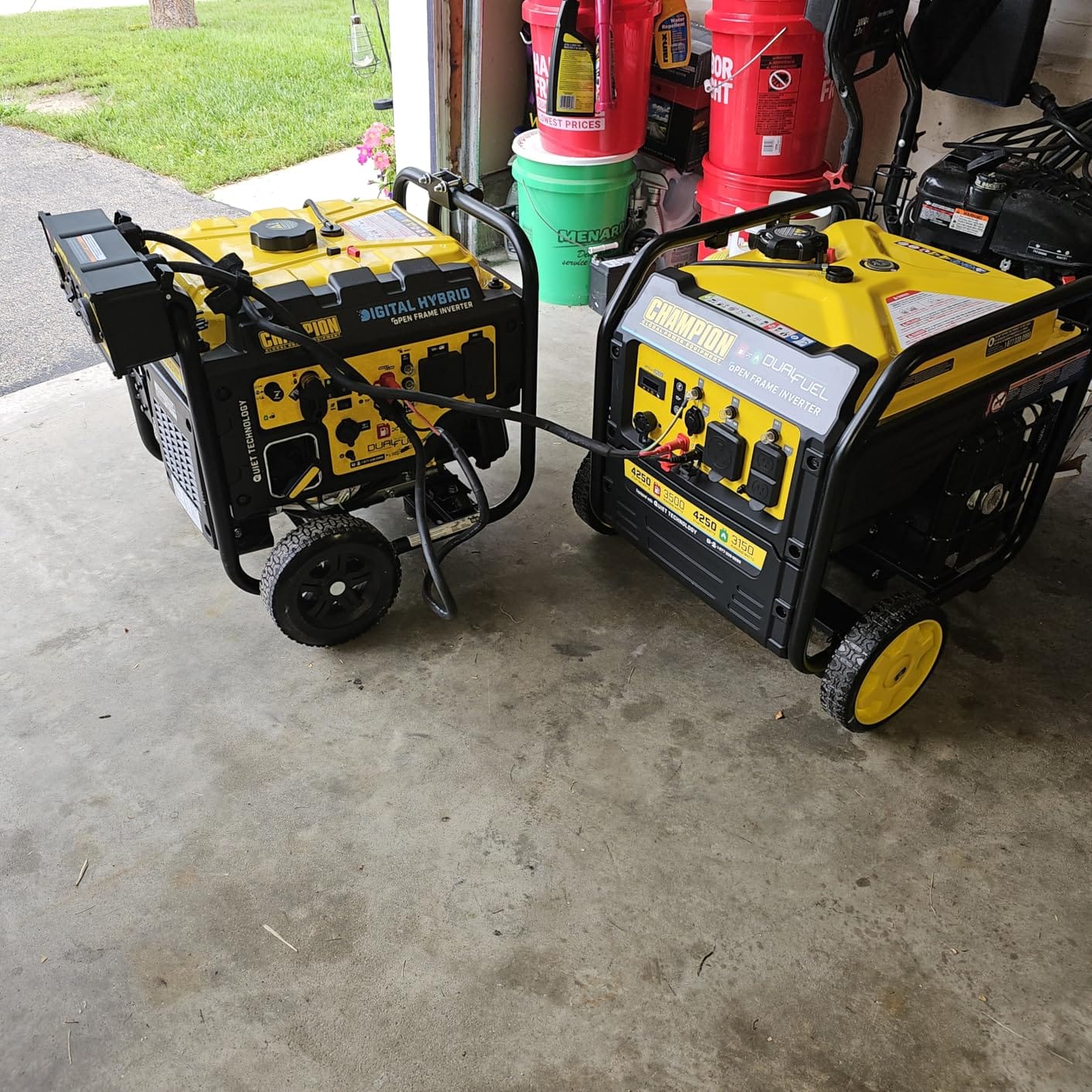
10. Champion 4250-Watt Open Frame Dual Fuel - The Longest Runtime Pick
Champion 4250-Watt Dual Fuel Portable Open Frame...
3500 running watts
4250 starting watts
79 pounds
64 dBA
4 gallon tank
22 hour runtime
What we like
- 4 gallon tank delivers up to 22 hours of gasoline runtime
- Full outlet package with 30A RV plus two 20A household plus 12V
- Dual fuel for long unattended propane runtime
- Parallel Ready via the ParaLINK kit
- 3-year warranty with lifetime technical support
What could be better
- 79 pounds and larger than most enclosed inverter machines
- Open frame leaves the engine exposed
- 64 dBA is on the louder side
Endurance is what this machine is for. A 4 gallon tank rated for up to 22 hours of gasoline runtime is roughly double what most machines in this class offer, and it changes how you plan a trip.
One owner running a Champion portable off a rear bumper mount with a davit reports running everything including the air conditioner on gasoline alone, and sees no need for dual fuel because they simply carry a container of gas.
Four gallon tank endurance
Output is 3500 running watts with 4250 at start from a 224cc four stroke. Dual fuel operation means you can also run long stretches on propane when unattended, which some owners prefer because propane stores without oxidising.
The outlet panel is complete: a 120V 30A RV outlet, two 120V 20A household outlets, and a 12V DC outlet with a dual USB adapter. Nothing to buy separately.
Open frame trade-offs
Open frame construction is 50 percent quieter and 20 percent lighter than a traditional Champion 3500 watt generator, but it also exposes the engine. If children or pets are around the machine, that matters. Noise is rated at 64 dBA, on the louder end of this roundup.
There is no remote start on this variant, so you are yanking a cord. At 79 pounds with a 27.9 by 23.4 by 21.7 inch footprint, mounting is mandatory rather than optional.
Who it suits
Buy it if you boondock for days without convenient fuel, if your biggest problem is refilling small tanks at night, or if you already have a mounting solution. It is also a strong outage backup unit for a house.
How To Size A Camping Generator For Your RV
A 30 amp RV service is 120V times 30A equals 3,600 watts. That is your ceiling. A 5000 watt generator can absolutely start a 30 amp RV, but the moment continuous draw passes 3,600W the RV breaker trips, and the extra starting capacity is the only thing you actually gain.
The sizing steps that work:
Step one. List every appliance you plan to run and find its running watts, which is the number printed on the label.
Step two. Find the starting or surge watts for anything with a compressor: rooftop air conditioner, refrigerator, microwave, water pump, air compressor.
Step three. Add your simultaneous running loads, then check the single largest starting load against your starting capacity.
Step four. Stay under 3,600W total, and keep headroom of 20 to 30 percent for inrush.
Step five. Pick a size class from this list rather than shopping by marketing number:
2,000 to 2,500 watts handles lights, a phone charger, a laptop, a small 12V fridge, and a small air conditioner only with an easy start kit. 3,000 to 3,500 watts handles a mid-size rooftop air conditioner plus basic appliances. 4,000 to 4,500 watts handles a 15000 BTU rooftop unit plus a few simultaneous loads. 5,500 watts and above is for 50 amp service, two air conditioners, or an installed unit on a Class A.
If you are on 50 amp service, stop reading the portable list. You need 120/240V output, which portable machines in this category do not provide. That is an installed generator or a properly engineered alternative.
One cheap fix worth knowing: an easy start kit on the air conditioner compressor reduces the inrush surge significantly, and owners who installed one on a smaller dual fuel machine report it resolved their starting problems.
Load Management: What Not To Run Alongside The Rooftop AC
A rooftop air conditioner dominates the budget. Once it is running, the remaining headroom on a 3000 watt machine is thin, and owners learn this the hard way.
Load combinations and what actually happens:
Rooftop AC plus microwave is the classic breaker trip. The microwave draws heavily for its cycle length. Turn the microwave off before you start the compressor.
Rooftop AC plus electric water heater is the other common trip. An electric water heater is a large resistive load that shares the same 30 amp service as the compressor.
Rooftop AC plus coffee maker is usually survivable but not comfortable. A hair dryer on high is the same category.
Air conditioner plus battery charging plus lights works fine and is the normal boondocking pattern.
The habit that fixes most problems: shut off heavy loads, start the compressor, wait 30 seconds for it to settle, then turn everything else back on. On propane the margin is smaller still, so this matters more.
Inverter Or Conventional Generator: Which One An RV Needs
An inverter generator uses a smaller engine running at a variable speed, then electronically smooths the output into a stable pure sine wave. A conventional generator runs wide open throttle and produces a rougher waveform.
For an RV, the inverter approach wins on three counts. First, total harmonic distortion stays under 3 percent, which protects electronics. Second, variable speed operation cuts noise and fuel burn at part load. Third, the engine runs cooler, which extends its life.
Conventional open frame units are louder, cheaper and better at sustained high output, which is why several remain in this roundup. If you run one heavy load continuously, an open frame design is defensible. If you run a computer next to the trailer, it is not.
Fuel Logistics On The Road: Gas Stations Versus Propane
The most useful piece of advice on this topic has nothing to do with wattage. Owners put it plainly: there are roughly ten times more places to find gasoline than places to fill propane tanks. Gas is available nearly everywhere; propane is not.
That single fact changes the dual fuel calculus. Dual fuel is valuable for storage flexibility and unattended runtime, but you should not depend on propane as your only fuel in remote areas.
Use ethanol-free high octane gasoline where you can find it. It reduces phase separation in stored fuel and cuts gum formation in the carburetor. Add a fuel stabilizer if the machine will sit between trips, run it down to empty if it will sit for months, and never store gasoline in anything other than an approved can.
One owner running dual fuel logged roughly 30 hours per 20 pound propane tank and boondocked 50 days before refilling. Another reports about a third of a gallon of propane per hour. Do your own arithmetic against your trip length.
Noise Bands And Campground Etiquette
Manufacturer noise figures are measured, but not consistently, and understanding the conditions explains most disagreements.
Under 50 dB is quieter than a whispered conversation. The Honda EU2200i sits here and disappears at camp.
50 to 60 dB is roughly a normal speaking voice. Acceptable at close sites. The PowerSmart, Pulsar and AIVOLT machines live here.
60 to 70 dB is noticeable in a quiet site and audible across an open campground loop. The Champion 4000, Champion 4250 and Champion 4500 sit here. Parking distance matters more than the number.
Over 70 dB is open frame territory. The Oxseryn measures under 72 dBA from 23 feet and owners describe cheaper open frame units as too loud for a civilized campground.
Three caveats on the numbers. Load matters: Eco mode at quarter load measures far better than full load. Distance matters: 23 feet is the standard test distance, and 50 feet sounds dramatically different. Surface matters: gravel and grass absorb, bare ground and hardpan reflect.
Check your campground decibel limits and national park quiet hours before you run anything overnight. Owners who solved a noise problem with a bigger machine often solved it better by moving the generator 50 feet from camp.
Reliability, Repairability, Storage And Theft Deterrence
This is where ranking pages usually go quiet, and where owners actually have strong opinions. A budget machine in the forum record failed under 200 running hours with piston wear and fuel in the oil, caught fire during a post-repair test run, and was written off. Regularly maintained Hondas started on the second pull after years.
What separates the two groups is parts support. A manufacturer with a dealer network, a published warranty of 2 or 3 years and available service parts is repairable. A machine with a 1-year warranty and no local support is disposable, and owners treat it accordingly. Three of the picks here carry 3-year warranties, three carry 2 years, and three carry 1 year.
Small fuel tanks are the other recurring grievance. If you hate refilling at bedtime, weigh tank volume above all else. The Champion 4250 with its 4 gallon tank and 22 hour rating solves it; several 1 gallon machines do not.
Storage and mounting deserve their own plan. Owners fabricate bumper mounts, davits and wall brackets, and one dedicated thread on carrying a heavy inverter generator on a trailer tongue or rear bumper drew significant traffic. Before you buy, check your storage compartment opening with a tape measure, not an estimate, and check its weight rating.
For theft deterrence, owners recommend a good quality cable lock so your investment does not grow legs. Do not leave a key in the ignition of a generator at a campsite.
Generator Versus Solar And Portable Power Stations
A portable power station with lithium batteries and solar panels makes sense when your loads are light and quiet matters absolutely: phones, laptops, cameras, a small fridge, LEDs. It is silent, zero maintenance indoors and needs no fuel logistics.
It does not make sense when you need air conditioning, a microwave or an electric water heater. Those loads demand thousands of watts continuously, and charging a battery bank from solar takes many hours of good sun.
The common full-time RVing answer is both. Solar and a power station handle the constant low draw through the day and the battery charging. The generator handles the rooftop air conditioner, the coffee maker and everything else on demand. If you already have a large solar array, a mid-size inverter like the Honda EU2200i covers the gaps without dominating the site.
Safety Rules For Running A Generator Around An RV
Never run a fuel powered generator inside an RV, a tent, a garage, a truck bed under a covered shell, or an enclosed storage bay. Carbon monoxide is odourless and lethal, and the failure mode is exactly the situation that feels convenient.
Keep the generator at least 20 feet from the RV with the exhaust pointed away from doors, windows, vents and slide-outs. This matters most in the morning and evening when people keep windows open.
Use a working carbon monoxide alarm inside the RV every trip, and treat the built-in CO sensor as a backup rather than a substitute. Built-in systems protect the machine; they do not protect you.
Let the generator cool before refueling, never refuel a hot engine, and store fuel only in approved containers away from ignition sources.
Respect the 30 amp service limit. Turn off heavy loads before starting or connecting, and never exceed the RV breaker rating to justify a bigger generator.
Frequently Asked Questions
How many watts generator do I need to run my RV?
A 30 amp RV service is 120V x 30A, which equals 3,600 watts maximum regardless of generator size. For one rooftop air conditioner, target a 4,000 to 4,500 watt inverter unit so the compressor has starting headroom. Add 20 to 30 percent spare capacity for inrush, and stay under 3,600W of continuous draw.
Will a 5000 watt generator run a 30 amp RV?
Yes, it will start and run a 30 amp RV, but the RV breaker still caps continuous draw at 3,600 watts. The extra 1,400 watts only buys starting headroom for compressors, not additional usable capacity. A 4,000 to 4,500 watt inverter covers the same real-world need in a lighter, quieter package.
What size generator is best for a 30-amp camper?
For most 30 amp campers, a 4,000 to 4,500 watt inverter generator is the sweet spot because it starts a 15000 BTU rooftop air conditioner and still leaves room for a few appliances. A 3,000 to 3,500 watt model works if you run a smaller air conditioner and manage loads. Below 2,500 watts will not reliably start a compressor.
What is the quietest generator for RV camping?
Enclosed-cabinet inverter generators are the quietest class. In this roundup the Honda EU2200i measures 48 to 57 dB(A), and the PowerSmart 3800 measures 59 dBA in Eco Mode. Open frame models run 61 to 72 dBA. Remember that figures are measured at part load from about 23 feet, so moving the unit farther from camp changes real noise more than the label does.
Is dual fuel worth it for an RV generator?
Dual fuel is worth it when propane is easy to refill near you, because it gives longer unattended runtime and stores without oxidising. Be aware that output drops on propane, and some smaller dual fuel machines will not start an air conditioner compressor on propane at all. Gasoline is available at roughly ten times more locations than propane, so keep gas as your primary fuel.
Final Verdict: Which RV Generator Should You Buy In 2026
If you run one rooftop air conditioner on a travel trailer with a 30 amp inlet, the Champion 4000-Watt Dual Fuel is the pick. It has the native TT-30R receptacle, 4000 starting watts and a documented record of starting a 15000 BTU compressor.
If you want the quietest possible setup and your loads are small, the Honda EU2200i wins. At 46.5 pounds and 48 to 57 dB(A) it is the benchmark, and the durability record over time is unmatched in this group.
If weight prevents you from lifting anything substantial, the Pulsar PGD40ISCO gives you 3200 running watts and 13500 BTU air conditioning capability at 47.3 pounds.
If budget drives the decision, the Oxseryn 4400 delivers the most output and a genuine RV port for the least money, at the cost of noise and a one-year warranty.
If refilling tanks in the dark is your biggest complaint, the Champion 4250 with its 4 gallon tank and 22 hour runtime removes the problem entirely. If lifting in the dark is your biggest complaint, the Champion 4500 with its electric start removes that one.
Before any of them, do the measuring. Check your storage bay opening, check your weight rating, buy an RV-rated generator cord rather than a household extension cord, install a carbon monoxide alarm, and run a full test cycle at home before you leave. That hour of preparation prevents most of the disappointments people report about the best camping generators for RV trips.