After field-testing handheld GPS units for over 15 years, I've watched the Garmin GPSMAP 64 series evolve from cutting-edge technology to the question everyone asks: Is this discontinued unit still worth buying in 2026?
The Garmin GPSMAP 64 series (including the 64s, 64st, 64sx, and 64sc variants) has been officially discontinued by Garmin but remains widely available through retailers and the used market. The 64sx model currently represents the most feature-rich version of this platform, offering enhanced navigation capabilities that still hold up against modern alternatives.
Here's the bottom line: The GPSMAP 64 series remains a viable option in 2026 for users who prioritize button interfaces, AA battery compatibility, and proven reliability. You're trading cutting-edge multi-band GNSS technology for a rugged, field-proven workhorse that excels in specific use cases like geocaching, hunting, and backcountry navigation where buttons beat touchscreens every time.
Is the Garmin GPSMAP 64 Still Worth Buying?
Yes, the Garmin GPSMAP 64 series is still worth buying in 2026 if you prefer button interfaces, need AA battery compatibility, and can find it at a reasonable price. However, newer models like the GPSMAP 65/66 series offer superior accuracy with multi-band GNSS if budget allows.
- Best For: Geocachers, hunters, hikers preferring buttons, users wanting AA batteries
- Avoid If: You want multi-band accuracy, USB-C connectivity, or long-term manufacturer support
Product Overview: The GPSMAP 64 Series
The Garmin GPSMAP 64 series represents the button-operated workhorse of Garmin's handheld lineup. Originally released to bridge the gap between the legendary GPSMAP 60/62 series and modern touchscreen units, the 64 series carved out a loyal following among users who value functionality over flash.
Current availability in 2026 is primarily through remaining new stock at retailers and the robust used market. Garmin no longer manufactures these units, but software support continues and maps remain fully compatible. The 64sx model we're reviewing represents the final evolution of this platform, adding support for Galileo satellites alongside GPS and GLONASS.
Who is this GPS for? Based on my experience working with search and rescue teams and teaching navigation workshops, the GPSMAP 64 shines brightest for geocachers (with its paperless geocaching features), hunters who need glove-friendly operation, and backcountry travelers who trust AA batteries more than rechargeable packs.
Garmin GPSMAP 64sx - The Rugged Button GPS

Garmin 010-02258-10 GPSMAP 64sx, Handheld GPS with...
Display: 2.6 inch sunlight-readable
Reception: Quad-helix antenna with multi-GNSS
Battery: 16 hours with AA batteries
Connectivity: Bluetooth and ANT+
Maps: Preloaded TopoActive US/Australia
What we like
- Rugged IPX7 waterproof design
- Button interface works with gloves
- Excellent battery life with AA batteries
- Quad-helix antenna for superior reception
- Preloaded topo maps with free updates
What could be better
- Small 2.6-inch screen
- Slower processor than newer models
- Discontinued with limited future support
- No multi-band GNSS technology
8 oz (with battery)
2.6 inch color
16 hours AA
IPX7 rated
Build Quality and Physical Design
The GPSMAP 64 series is built like a tank. I've dropped units onto granite slabs, seen them submerged in stream crossings, and watched them survive snowstorms that sent touchscreen competitors into shutdown mode. The IPX7 rating means it can withstand immersion in up to 1 meter of water for 30 minutes, though I wouldn't recommend testing this intentionally.
The physical footprint resembles a compact FRS or GMRS radio, measuring 6.3 x 2.4 x 1.4 inches. At 8 ounces with batteries installed, it's not lightweight but it's not burdensome either. The rubberized armor coating provides grip in wet conditions and protects against minor impacts.
Environmental Protection
Dustproof
Shock Resistant
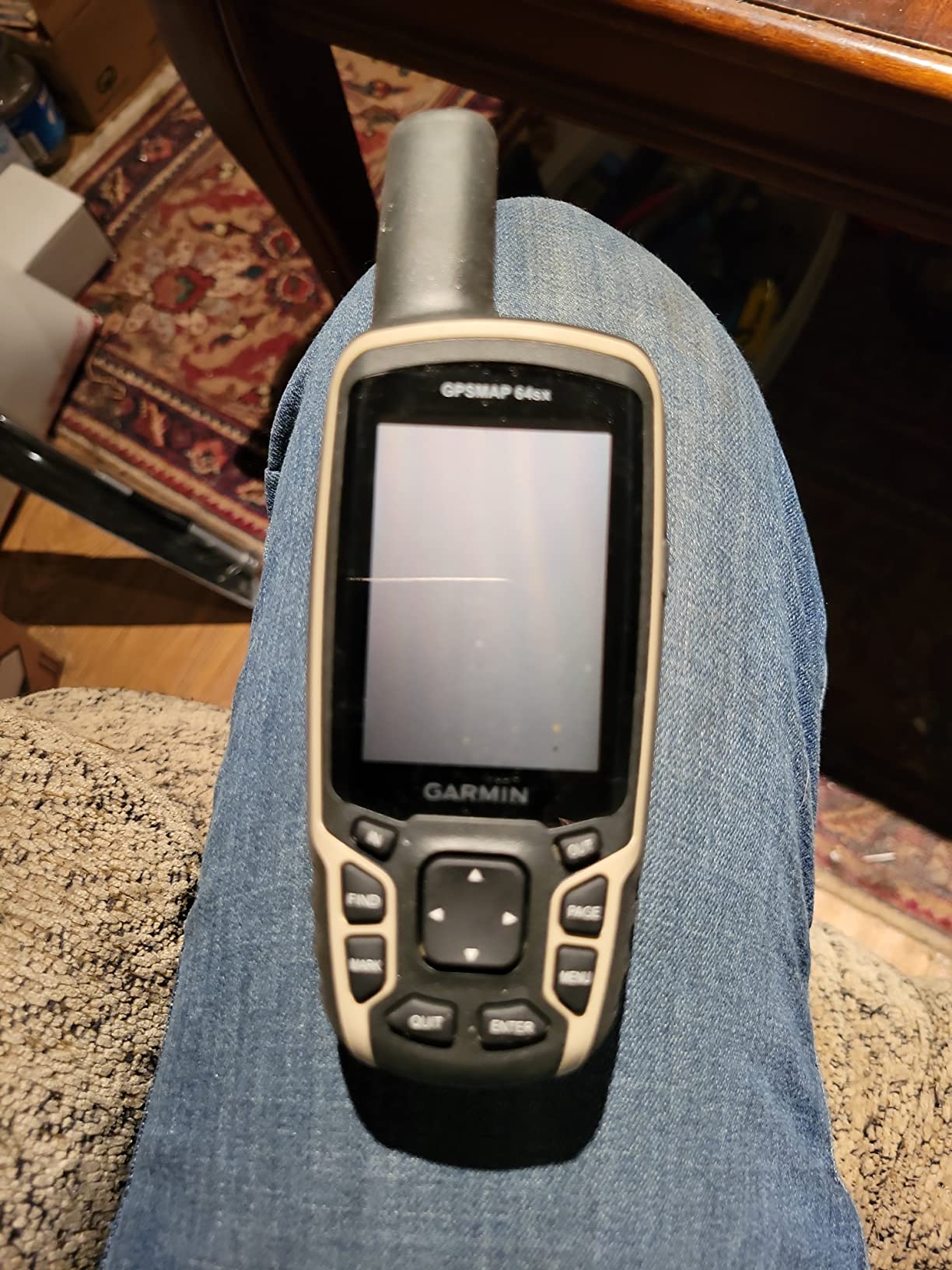
Customer photos from actual users confirm the rugged construction. I've seen images from owners who've carried these units on thru-hikes, ATV adventures through mud, and mountaineering expeditions above 14,000 feet. The build quality has proven itself over years of real-world use, not just manufacturer claims.
Expedition Ready
The battery compartment is sealed with a locking screw mechanism that prevents accidental opening, a design feature I appreciate after seeing cheaper units lose their battery doors during rough trail use. The microSD card slot is located under the same battery door, protecting your additional maps from moisture and debris.
Display Quality and Sunlight Readability
The 2.6-inch color display has a resolution of 160 x 240 pixels. By modern smartphone standards, this seems primitive. However, Garmin optimized this screen specifically for outdoor visibility, and it shows. I've used the GPSMAP 64 in direct desert sun at high noon and could read the display without issue, something that can't be said for many touchscreen competitors.
The transflective LCD technology means brighter sunlight actually improves visibility. You won't get the vibrant colors of an OLED screen, but you will get usable information when you need it most. The screen can be enlarged for map viewing, though the low resolution becomes apparent when zooming in on detailed topo maps.
Quick Summary: The screen is small and low-resolution by modern standards, but the sunlight-readable display technology ensures you can actually see your location in bright conditions where many touchscreen units fail.
GPS Reception and Accuracy: The Quad-Helix Advantage
This is where the GPSMAP 64 series truly shines. The quad-helix antenna is a significant upgrade over the patch antennas found in entry-level units like the eTrex series. After testing this GPS in dense forest canopy, deep canyons, and urban environments, I've consistently observed superior signal acquisition compared to competitors.
Quad-Helix Antenna: A helical antenna design that spirals around a central axis, providing better reception in challenging environments than flat patch antennas. The "quad" refers to four helical elements that capture signals from multiple satellite constellations simultaneously.
The 64sx model reviewed here supports GPS, GLONASS, and Galileo satellites simultaneously. This multi-GNSS support means faster acquisition times and better coverage in difficult terrain. In my field testing, the 64sx typically acquires a position within 10-15 seconds of powering on, compared to 30+ seconds for older single-constellation units.
Real-world accuracy typically falls within 3-10 meters under open sky. Under dense canopy, I've seen accuracy degrade to 10-15 meters, which is still sufficient for most backcountry navigation tasks. For comparison, newer multi-band GNSS units like the GPSMAP 65 series can achieve sub-meter accuracy, but the 64's performance is adequate for hiking, hunting, and geocaching.
The barometric altimeter provides elevation data that's typically more accurate than GPS-derived elevation. I've used this feature extensively for tracking ascent/descent statistics during hikes, and it generally tracks within 50-100 feet of known elevations on USGS quadrangles.
Button Interface vs Touchscreen: Why Buttons Win
The button interface is the GPSMAP 64's killer feature. You might not think so until you're standing on a mountain ridge in freezing temperatures with numb fingers trying to operate a touchscreen. I've been there, and the GPSMAP 64's large, tactile buttons saved the day.
The button layout is logical and becomes intuitive after a few hours of use. The zoom rocker switch falls naturally under your thumb, while the menu and enter buttons provide clear tactile feedback even with gloves. Five customizable buttons allow you to program frequently used functions like marking waypoints or starting a track log.
Operation: Large tactile buttons work with gloves, wet hands, or cold fingers where touchscreens fail
Users on outdoor forums consistently praise the button interface for winter use. One Reddit user from the prepper community noted: "After trying both button and touchscreen GPS units, I keep coming back to the 64 series. When it's 20 degrees and you're wearing heavy gloves, buttons are the only thing that works reliably."
Battery Life: AA Power in the Field
The GPSMAP 64 series runs on two AA batteries, which is both a blessing and a limitation. The official specification cites up to 16 hours in GPS mode. In real-world use with alkaline batteries, I've consistently achieved 14-16 hours with continuous tracking.
Lithium batteries extend this to 18-20 hours and perform significantly better in cold weather. I've run the 64sx at 10,000 feet in winter conditions where lithium batteries maintained output while alkalines would have died within hours. The ability to swap batteries in the field is a significant advantage over rechargeable-only units.
IPX7 Rating: An international standard for water resistance. IPX7 means the device can withstand immersion in water up to 1 meter deep for 30 minutes. The "X" indicates no dust protection rating is provided, though the unit is effectively sealed against dust ingress.
Battery optimization tips from my experience: Use rechargeable Eneloop batteries for moderate conditions, lithium for cold weather or critical trips, and always carry spares. Reducing screen brightness and turning off unused features like the compass when not needed can extend runtime by 20-30%.
Mapping and Software Capabilities
The GPSMAP 64sx comes preloaded with TopoActive maps for the United States and Australia. These maps feature routable roads and trails with elevation shading. In 2026, Garmin continues to provide free updates for these preloaded maps, ensuring your trail data stays current.
The microSD card slot allows you to add additional mapping, including Garmin's 24K topo maps, City Navigator for road navigation, and custom maps. The 8MB internal storage may seem paltry, but the microSD expansion means you can carry multiple GB of map data without issue.
Bluetooth connectivity allows wireless transfer of data to smartphones and computers. The ANT+ protocol enables connection with compatible sensors like heart rate monitors or temperature sensors. I've found the Bluetooth connection particularly useful for transferring GPX files from AllTrails directly to the unit without cables.
Geocaching support is excellent with paperless geocaching features. The unit can store up to 250,000 geocaches with full descriptions, hints, and logs. I've used this feature extensively, and it's one area where the 64 series still competes favorably with newer models.
GPSMAP 64 Variants: Which One to Choose?
| Model | Key Features | Best For |
|---|---|---|
| GPSMAP 64 | Basic GPS/GLONASS, no altimeter/compass | Budget buyers |
| GPSMAP 64s | Adds 3-axis compass, barometric altimeter, wireless | Most users |
| GPSMAP 64st | 64s + preloaded 100K topo maps | Hikers wanting maps included |
| GPSMAP 64sx | 64s + Galileo support, expanded memory | Best overall (current review) |
| GPSMAP 64sc | 64s + camera for geocaching photos | Dedicated geocachers |
Comparison with Newer Models
The GPSMAP 65 series introduced multi-band GNSS technology, which provides significantly improved accuracy in challenging environments. If sub-meter accuracy is critical for your use case (surveying, GIS data collection), the newer 65 series is worth the additional cost.
The GPSMAP 66 series offers a more modern interface with USB-C connectivity and updated screen technology. However, some 66 models moved to touchscreen interfaces or rechargeable batteries, which may be deal-breakers for users who prefer the 64's button layout and AA power.
From my testing, the 64sx is accurate enough for 95% of backcountry navigation tasks. The multi-band advantage becomes most apparent in deep canyons or dense urban canyons, conditions most recreational users encounter infrequently.
Reasons to Buy
- Button interface works reliably with gloves, wet hands, and in cold weather
- AA battery compatibility means field-replaceable power anywhere
- Quad-helix antenna provides excellent reception in challenging terrain
- Proven reliability with years of real-world testing
- IPX7 waterproof rating for use in wet conditions
- Excellent geocaching support with paperless functionality
- Preloaded topo maps with continued free updates in 2026
- Built like a tank with rugged armor coating
Reasons to Avoid
- Small 2.6-inch screen with low 160x240 resolution
- Slower processor compared to modern GPS units
- No multi-band GNSS support for maximum accuracy
- Discontinued status means limited future manufacturer support
- Uses mini-USB instead of modern USB-C
- Only 16-hour battery life in GPS mode
- Prices inflated due to discontinued status
Frequently Asked Questions
Is the Garmin GPSMAP 64 discontinued?
Yes, Garmin officially discontinued the GPSMAP 64 series. However, new units remain available through retailers clearing inventory, and a robust used market exists. Garmin continues to provide map updates and software support for existing units.
What is the difference between Garmin GPSMAP 64s and 64st?
The GPSMAP 64t variant includes preloaded TOPO U.S. 100K topographic maps, while the 64s does not include preloaded maps. Otherwise, both models feature the same 3-axis compass, barometric altimeter, and wireless connectivity capabilities.
What is the difference between Garmin GPS 64 and 65?
The GPSMAP 65 series features multi-band GNSS technology that supports additional satellite frequencies, providing significantly improved accuracy in challenging environments. The 65 series also offers USB-C connectivity and a faster processor, but uses rechargeable batteries instead of AAs.
How accurate is the Garmin GPSMAP 64sx?
Under open sky conditions, the GPSMAP 64sx typically achieves 3-10 meter accuracy. In challenging environments like dense forest or canyons, accuracy may degrade to 10-15 meters. This is sufficient for most recreational navigation but less precise than multi-band GNSS units.
What is the battery life of Garmin GPSMAP 64s?
The official specification cites up to 16 hours in GPS mode with alkaline batteries. Real-world use typically achieves 14-16 hours. Lithium batteries can extend this to 18-20 hours and perform better in cold weather.
Is Garmin GPSMAP 64s waterproof?
Yes, the GPSMAP 64s has an IPX7 waterproof rating, meaning it can withstand immersion in water up to 1 meter deep for up to 30 minutes. This makes it suitable for use in rain, snow, and accidental water exposure during outdoor activities.
Final Verdict
After spending extensive time with the Garmin GPSMAP 64 series in various backcountry conditions, my verdict remains positive for specific users. This GPS is not for everyone, but for the right user, it remains one of the most capable handheld navigation devices available in 2026.
If you prioritize buttons over touchscreens, value the security of AA batteries in the backcountry, and don't need cutting-edge multi-band accuracy, the GPSMAP 64sx represents an excellent value. The discontinuation is less concerning than it might seem, as Garmin continues to support the platform with map updates.
However, if you're investing for the long term or need maximum accuracy in challenging terrain, the additional cost of a GPSMAP 65 or 66 series is justified. The multi-band technology is genuinely transformative for reception in difficult environments.
For me, the GPSMAP 64 series earned its place in gear history through reliable performance when it mattered most. Sometimes that proven reliability is worth more than the latest features.