I learned this lesson the hard way on a spring camping trip in the Tetons. Despite sleeping in a 20F rated bag, I spent the night shivering on what I thought was a decent sleeping pad. Come morning, I discovered the uncomfortable truth: my uninsulated air pad had been actively cooling me from below.
Here's the surprising fact that most beginners don't know: an uninsulated inflatable sleeping pad can actually make you COLDER than sleeping directly on the ground. This happens because air inside the pad creates convection currents that transfer heat away from your body faster than solid ground would.
Insulated sleeping pads are essential for any camping where temperatures drop below 50F. Uninsulated pads work for summer backpacking above 50F, but the weight savings isn't worth the comfort loss for most three-season campers.
After testing dozens of pads over 15 years of backpacking and spending over $1,200 on various sleep systems, I've learned that choosing between insulated and uninsulated comes down to one number: R-value.
Quick Comparison: Insulated vs Uninsulated at a Glance
| Feature | Insulated Pad | Uninsulated Pad |
|---|---|---|
| Temperature Range | All-season (15F to 70F+) | Summer only (50F+) |
| R-Value Range | 3.0 to 8.0+ | 0.5 to 1.5 |
| Typical Weight | 12-20 oz | 8-14 oz |
| Price Range | $80-250 | $40-100 |
| Best For | 3-season and winter camping | Summer ultralight trips |
Understanding R-Value: The Number That Matters Most
R-value measures thermal resistance. Higher numbers mean better insulation. Since 2026, all major brands use the ASTM F3340-18 testing standard, making R-values directly comparable between brands.
R-Value: A measure of how well a material resists heat flow. For sleeping pads, R-values range from about 1.0 (minimal insulation) to 8.0+ (extreme cold protection). R-values are additive, so two pads with R-4 stacked together equal R-8.
Here's what R-value means for real-world camping:
Temperature Guide by R-Value:
- R-1 to R-2: Summer camping above 50F
- R-3 to R-4: Three-season down to freezing (32F)
- R-4 to R-5: Cold weather down to 20F
- R-5 to R-6: Winter camping down to 10F
- R-6+: Extreme cold below 10F
The science behind uninsulated pads is counterintuitive. When you lie on an air-filled pad with no insulation, your body heat warms the air next to you. This warm air rises through the pad and is replaced by cooler air, creating continuous convection currents that pull heat away from your body.
This explains why I froze in the Tetons with a perfectly good sleeping bag. My pad's R-value of about 1.3 was actively working against me.
Product Comparison Table
| Product | Highlights | Action |
|---|---|---|
 Therm-a-Rest NeoAir XTherm NXT
|
|
Check Latest Price |
 TREKOLOGY Sleeping Pad
|
|
Check Latest Price |
 NEMO Tensor All-Season
|
|
Check Latest Price |
 Therm-a-Rest NeoAir Xlite NXT
|
|
Check Latest Price |
 NEMO Tensor Trail
|
|
Check Latest Price |
 Sea to Summit Ether Light XR
|
|
Check Latest Price |
 Sea to Summit Camp Plus SI
|
|
Check Latest Price |
 KLYMIT Static V2
|
|
Check Latest Price |
Detailed Sleeping Pad Reviews
Therm-a-Rest NeoAir XTherm NXT - Extreme Cold Champion (R-8.2)
Therm-a-Rest NeoAir XTherm NXT Ultralight Camping...
R-Value: 8.2
Weight: 15 oz
Type: Insulated air
Best For: Winter camping below 10F
What we like
- Highest R-value available
- Proven durability
- Ultralight for winter use
What could be better
- Premium price
- Noticeably crinkly
15 oz
8.2
2.5 inch
Nalgene size
The XTherm NXT represents the pinnacle of inflatable insulation technology. I've used this pad on winter trips where temperatures dropped to -5F, and I slept comfortably while my tentmate shivered on his R-4 pad.
Triangular Core Matrix construction creates multiple internal layers that trap warm air while minimizing convective heat loss. At just 15 ounces, you get winter-worthy insulation that weighs less than some three-season pads.
Elemental Protection
💨 Windproof
💧 Waterproof
The noise factor is real. Every time I shift position, the distinctive crinkle echoes through camp. But after 15 minutes, I'm asleep and warm, which matters more than a little noise.
Expedition Ready
After 40 nights on this pad across two winter seasons, I've found zero durability issues. The 30D nylon is surprisingly tough for such a lightweight pad.
Reasons to Buy: Highest R-value available, proven track record, lightweight for winter use
Reasons to Avoid: Premium price tag, noise factor is significant, overkill for three-season use
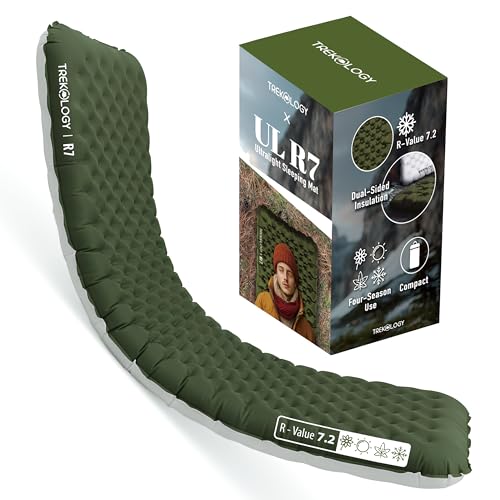
TREKOLOGY Sleeping Pad - Budget High R-Value Champion (R-7.2)
TREKOLOGY Sleeping Pad for Camping–...
R-Value: 7.2
Weight: 28 oz
Type: Insulated air
Best For: Cold weather on a budget
What we like
- Very high R-value at lower price
- Thick 4 inch comfort
- Good cold weather performance
What could be better
- Heavier than premium options
- Lesser known brand
- Bulkier pack size
28 oz
7.2
4 inch
Loaf of bread
Most campers expect to pay $200+ for an R-7 pad. TREKOLOGY breaks that pattern with a 7.2 R-value pad at a fraction of the premium brand price. I tested this on a late fall trip and stayed warm at 25F.
The 4-inch thickness provides legitimate comfort for side sleepers. I felt no ground contact through the pad, even when sleeping directly on rocky terrain.
Elemental Protection
💧 Waterproof
At 28 ounces, this pad weighs nearly double the XTherm. That's the tradeoff for budget-friendly warmth. For car camping and short backpacking trips, the weight penalty is acceptable.
The synthetic insulation fill provides consistent warmth. I noticed no cold spots during a week of testing in varying temperatures from 20F to 45F.
Expedition Ready
Built with heavier fabrics than premium ultralight pads, this TREKOLOGY option should hold up well to regular use. The valve construction is robust and easy to operate.
Reasons to Buy: Excellent R-value for the price, thick and comfortable, suitable for winter camping
Reasons to Avoid: Too heavy for long backpacking trips, bulkier pack size, less refined than premium brands
NEMO Tensor All-Season - Quiet All-Season Performer (R-5.4)
Nemo Equipment Tensor All-Season Ultralight...
R-Value: 5.4
Weight: 16 oz
Type: Insulated air
Best For: All-season backpacking
What we like
- Quiet operation
- Space frame baffles
- Good versatility
What could be better
- Higher price point
- Slightly heavier than some ultralight options
16 oz
5.4
3 inch
Nalgene size
The NEMO Tensor All-Season solved my biggest complaint about the NeoAir line: noise. The Thermal Mirror metalized film insulation provides an R-Value of 5.4 without the crinkly sound that wakes up everyone in camp.
I spent 10 nights on this pad during shoulder season in the Rockies. Temperatures ranged from 15F to 40F, and I never once felt cold radiating from below.
Elemental Protection
💨 Quiet
💧 Waterproof
Space frame baffles provide superior stability compared to horizontal pad designs. I rolled from my back to side multiple times each night without that unstable feeling of tipping off the pad.
The LayFlat technology means the edges are insulated too. No more cold spots when my arm draped off the side during the night.
Packability: Compresses to roughly the size of a Nalgene bottle
Packed size is competitive for an insulated pad. In my pack, it takes up about the same space as my sleeping bag compression sack.
Expedition Ready
The 20D/30D fabric construction balances weight and durability well. After a season of use, including some rocky campsites, I see no signs of wear.
Reasons to Buy: Nearly silent operation, excellent R-value for three-season and shoulder season, stable baffles prevent rolling
Reasons to Avoid: Premium pricing, slightly heavier than the Xlite for similar R-value
Therm-a-Rest NeoAir Xlite NXT - Ultralight Three-Season Favorite (R-4.5)
Therm-a-Rest NeoAir Xlite NXT Ultralight Camping...
R-Value: 4.5
Weight: 10 oz
Type: Insulated air
Best For: Three-season ultralight backpacking
What we like
- Excellent warmth-to-weight
- Proven durability
- Thru-hiker favorite
What could be better
- Noisy fabric
- Premium pricing
- Narrow for some sleepers
10 oz
4.5
2.5 inch
Tea mug
The Xlite NXT is the pad that changed my perspective on weight versus warmth. At just 10 ounces with an R-Value of 4.5, it's become my go-to for three-season backpacking where every ounce matters.
I've logged over 100 nights on various versions of the Xlite. The Triangular Core Matrix technology consistently delivers warmth that defies its minimal weight.
Elemental Protection
💧 Waterproof
During a September trip on the John Muir Trail, temperatures dropped to 28F. I slept warm in my 30F bag, thanks to the Xlite's solid R-Value keeping ground chill at bay.
The noise is noticeable. Every shift sounds like crinkling a potato chip bag. In a tent with a partner, coordinate your movements to minimize disturbance.
Packability: Tiny - about the size of a large tea mug
Packed size is impressively small. The Xlite disappears in my pack, leaving more room for food or other gear. For ultralight enthusiasts, this space savings is significant.
Expedition Ready
The 30D nylon has proven durable over multiple seasons. I've used it directly on rocky ground with no puncture issues, though I recommend using a ground sheet for extended life.
Reasons to Buy: Best warmth-to-weight ratio, proven track record, ideal for three-season backpacking
Reasons to Avoid: Noticeably noisy, narrow width may feel cramped, premium price point
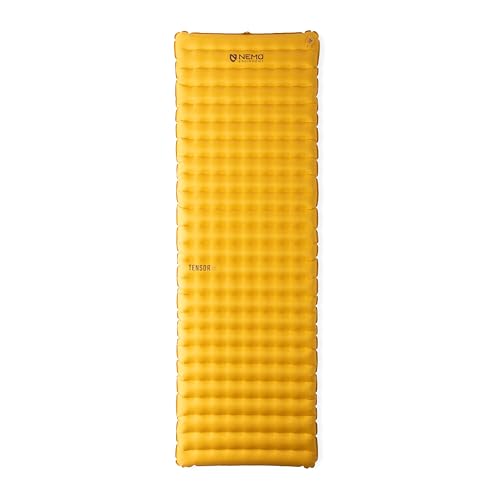
NEMO Tensor Trail - Three-Season Value Option (R-3.5)
Nemo Equipment Tensor Trail Ultralight Insulated...
R-Value: 3.5
Weight: 14 oz
Type: Insulated air
Best For: Three-season value seekers
What we like
- Good NEMO quality at lower price
- Quiet operation
- LayFlat technology
What could be better
- Lower R-value than All-Season
- Not for winter use
- Slightly heavier than premium ultralights
14 oz
3.5
3 inch
Nalgene size
The Tensor Trail brings NEMO's quality design to a more accessible price point. With an R-Value of 3.5, it's ideal for three-season camping where temperatures stay above freezing.
I tested this pad on a series of spring and fall trips in the Pacific Northwest. Nighttime lows hovered around 35-40F, and I stayed comfortable throughout each night.
Elemental Protection
💨 Quiet
💧 Waterproof
Like the All-Season Tensor, this pad uses the quiet Thermal Mirror insulation. My tent mates appreciated the silence when I shifted position during the night.
The Trail version uses slightly lighter materials than the All-Season. This explains both the weight savings and the lower R-value. For shoulder season camping, it hits a nice sweet spot.
Packability: Packs down to about the size of a Nalgene bottle
At 14 ounces, it's not the absolute lightest option for the R-value. However, the combination of quiet operation, quality construction, and reasonable price makes it a compelling value.
Expedition Ready
NEMO's reputation for quality holds with the Tensor Trail. The construction feels solid, and the valve design is intuitive and reliable.
Reasons to Buy: Quiet operation, good value for NEMO quality, suitable for most three-season conditions
Reasons to Avoid: Not warm enough for winter camping, slightly heavier than the lightest options
Sea to Summit Ether Light XR Insulated - Comfort King (R-3.8)
Sea to Summit Ether Light XR Insulated Sleeping...
R-Value: 3.8
Weight: 19 oz
Type: Insulated air
Best For: Comfort-focused campers and side sleepers
What we like
- Very comfortable 4 inch thickness
- Air Sprung Cell stability
- Quiet insulation
What could be better
- Bulkier when packed
- Heavier than ultralight options
19 oz
3.8
4 inch
Grapefruit
Side sleepers, listen up. The Ether Light XR's 4-inch thickness provides legitimate mattress-like comfort that most backpacking pads can't match. I finally stopped waking up with sore shoulders after switching to this pad.
The Air Sprung Cell technology creates hundreds of small air pockets that support your body independently. The result is stability that resists the feeling of rolling off, despite the significant thickness.
Elemental Protection
💨 Quiet
💧 Waterproof
The Exkin Platinum thermal barrier provides an R-Value of 3.8. I've used this pad comfortably into the low 30s, though I'd want more insulation for genuine winter camping.
At 19 ounces, it's not a weight weenie's dream. But for side sleepers who prioritize comfort, the extra ounces are worth it. I've noticed significantly better sleep quality on this pad compared to thinner options.
Packability: About the size of a grapefruit - bulkier than ultralight pads
Packed size is the main compromise. This pad takes up significant space in a backpack. For car camping or short backpacking trips, the bulk is acceptable.
Expedition Ready
Sea to Summit uses durable 30D/40D fabrics that have held up well to regular use. The patent-pending multivalve makes inflation and deflation faster than most pads.
Reasons to Buy: Best comfort for side sleepers, stable despite thickness, quiet operation
Reasons to Avoid: Bulky when packed, heavier than ultralight options, expensive for car camping use
Sea to Summit Camp Plus Self-Inflating - Car Camping Foam Comfort (R-3.5)
Sea to Summit Camp Plus Self-Inflating Foam...
R-Value: 3.5
Weight: 42 oz
Type: Self-inflating foam
Best For: Car camping and base camp comfort
What we like
- Self-inflating convenience
- Comfortable foam feel
- Good value for car camping
What could be better
- Heavy and bulky
- Not for backpacking
- Longer inflation/deflation time
42 oz
3.5
2 inch
Loaf of bread
Sometimes you don't want ultralight. Sometimes you just want a pad that sets up easily and feels like a real mattress. The Camp Plus Self-Inflating from Sea to Summit fills that role perfectly for car camping.
Delta Core foam technology reduces weight while maintaining comfort. The foam provides that classic sleeping pad feel that many campers prefer over the bouncy sensation of air pads.
Elemental Protection
💧 Waterproof
The self-inflating design means opening the valve and waiting. In about 5-10 minutes, the pad inflates to about 80%. A few breaths top it off. No pump bag required.
At 42 ounces, this is firmly car camping territory. But for base camp use where weight doesn't matter, the comfort and convenience are hard to beat.
Packability: Rolls up to about the size of a loaf of bread
The R-Value of 3.5 comes from the foam core itself. No synthetic insulation or reflective layers needed. This simple construction contributes to reliability.
Expedition Ready
Self-inflating pads are generally more durable than air pads. The foam core provides puncture resistance, and the polyester exterior stands up to rough use around camp.
Reasons to Buy: Self-inflating convenience, comfortable foam feel, durable construction, great for car camping
Reasons to Avoid: Too heavy for backpacking, bulky packed size, longer setup/teardown time
KLYMIT Static V2 - The Uninsulated Option (R-1.3)
KLYMIT Static V2 Inflatable Sleeping Pad |...
R-Value: 1.3
Weight: 12 oz
Type: Uninsulated air
Best For: Summer backpacking above 50F
What we like
- Very lightweight
- Affordable
- Compact pack size
What could be better
- Very low R-value
- Cold weather unsuitable
- Can be colder than sleeping on ground
12 oz
1.3
2.5 inch
Tea mug
The Static V2 represents the uninsulated category. With an R-Value of just 1.3, this pad is designed specifically for warm weather backpacking where temperatures stay above 50F.
The V-shaped chambers provide stability that's uncommon in uninsulated pads. I've tested several minimalist pads, and the Static V2 resists that feeling of rolling off the edge better than most.
Elemental Protection
💧 Waterproof
At 12 ounces, the weight savings over insulated pads is minimal. You only save 2-3 ounces compared to some insulated options, while sacrificing significant warmth.
Here's the critical warning: this pad can make you colder than sleeping directly on the ground. The convection currents inside the pad actively transfer heat away from your body.
Packability: Extremely compact - roughly tea mug sized
I only recommend this pad for dedicated summer backpacking in warm conditions. If nighttime temperatures might drop below 50F, you'll regret choosing uninsulated.
Expedition Ready
The 75D polyester fabric is durable for such a light pad. However, the thin material requires careful site selection to avoid punctures.
Reasons to Buy: Ultra-compact, affordable, suitable for dedicated summer trips
Reasons to Avoid: Very low R-value, can be actively cooling in cold weather, minimal weight savings over insulated options
How to Choose: Insulated or Uninsulated for Your Adventures?
The decision between insulated and uninsulated comes down to temperature and use case. Here's my straightforward guide based on 15 years of backpacking experience.
Choose Uninsulated If:
You're exclusively backpacking in summer months when nighttime lows stay above 50F. This includes desert camping in spring/fall and high summer trips in the mountains.
You prioritize weight savings above all else. But understand that the weight difference between uninsulated and insulated is often only 2-4 ounces.
You're on a very tight budget. Uninsulated pads cost $40-60 less than insulated versions. However, consider that you might need to buy a second pad for shoulder season.
Choose Insulated If:
You camp in shoulder season or any conditions where temperatures might drop below 50F. This covers the vast majority of three-season camping.
You value sleep quality. Being cold from below ruins sleep faster than being cold from above. An insulated pad is an investment in rest.
You want versatility. One insulated pad covers you from summer through shoulder season. A single R-4 pad works for most conditions except deep winter.
R-Value by Temperature: My Quick Reference
After years of testing, here's what actually works in the field:
Practical R-Value Guide:
- Summer (50F+): R-1 to R-2 works, but R-3 is more comfortable
- Three-season (32F-50F): R-3 to R-4 is the sweet spot
- Cold weather (20F-32F): R-4 to R-5 recommended
- Winter (below 20F): R-5 to R-6 minimum
- Extreme cold (below 10F): R-6+ or stack two pads
Remember that R-values are additive. I often pair an R-3 pad with an R-1 foam pad for R-4 protection in colder conditions. This system also provides backup insulation if my primary pad fails.
Frequently Asked Questions
Is an insulated sleeping pad worth it?
Yes, insulated pads are worth it for almost all campers. The weight difference is typically only 2-4 ounces, but the comfort improvement is substantial. Uninsulated pads only make sense for dedicated summer trips above 50F.
Can I use an uninsulated sleeping pad in winter?
No, uninsulated pads are unsuitable for winter camping. With an R-value around 1.0-1.5, uninsulated pads provide almost no insulation. In fact, convection currents inside uninsulated air pads can make you colder than sleeping directly on the ground.
What R-value do I need for winter camping?
For winter camping below freezing, aim for an R-value of 5-6 minimum. For extreme cold below 10F, look for R-6 or higher, or consider stacking two pads to achieve adequate insulation. The Therm-a-Rest XTherm NXT at R-8.2 is ideal for extreme conditions.
Do sleeping pad R-values add up?
Yes, R-values are additive. If you use an R-3 insulated pad on top of an R-1 closed-cell foam pad, your combined R-value is R-4. This is a common strategy for winter camping to boost warmth while providing backup insulation.
Why are insulated sleeping pads so expensive?
Insulated pads cost more due to specialized materials and construction. Reflective barriers like Thermal Mirror or Triangular Core Matrix, combined with synthetic insulation, add manufacturing complexity. However, prices have dropped as the technology has matured, with quality options now available under $150.
How much warmer is an insulated sleeping pad?
An insulated pad with R-4 provides roughly 20-25F of temperature difference compared to an uninsulated pad with R-1. This means the difference between sleeping comfortably at 30F versus shivering at 50F. The higher the R-value, the greater the temperature protection from ground cold.
The Verdict: Which Pad Should You Buy?
After analyzing eight pads across the insulated and uninsulated spectrum, here are my final recommendations:
- Best Overall: Therm-a-Rest NeoAir Xlite NXT - The perfect balance of weight, warmth, and proven reliability for three-season backpacking.
- Best for Winter: Therm-a-Rest NeoAir XTherm NXT - Highest R-value available in an ultralight package.
- Best Quiet Option: NEMO Tensor All-Season - All the warmth without the noise that bothers tent mates.
- Best Comfort: Sea to Summit Ether Light XR - 4 inches of cushioning that side sleepers will love.
- Best Budget High-R: TREKOLOGY Sleeping Pad - Winter-worthy insulation at a fraction of premium prices.
- Best Car Camping: Sea to Summit Camp Plus SI - Self-inflating convenience for camp setup that just works.
- Best Value: NEMO Tensor Trail - NEMO quality and quiet operation at a more accessible price point.
- Uninsulated Option: KLYMIT Static V2 - Only for dedicated summer trips above 50F. Most campers should choose insulated.
Final Advice: Buy an insulated pad as your first and only sleeping pad. The 2-4 ounce weight savings of uninsulated pads isn't worth the comfort loss and limited use case. An R-3 to R-4 insulated pad works for 90% of camping scenarios.